About us
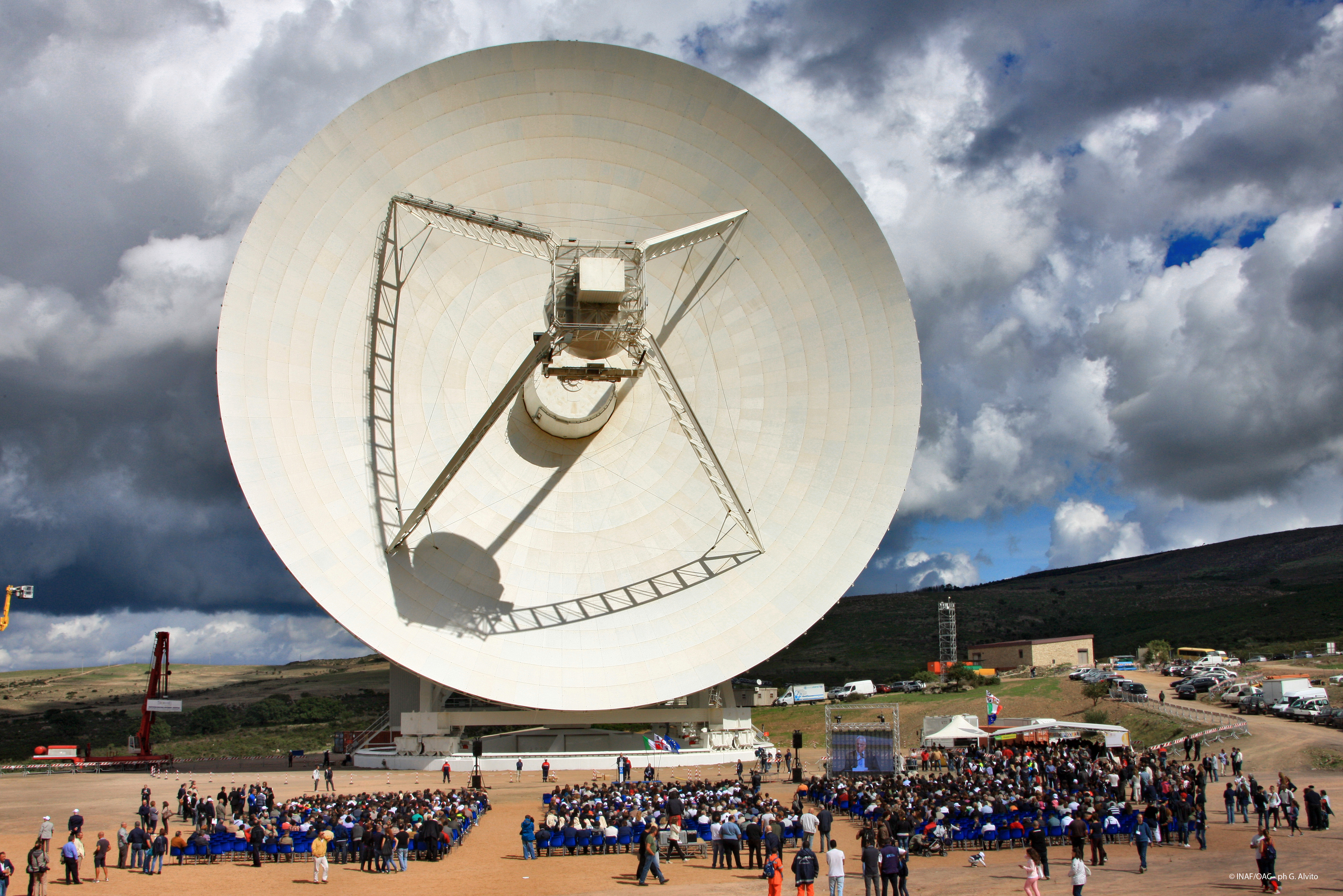
Designed in the 1990s and 2000s, the Sardinia Radio Telescope is the result of a scientific and technical project shared between the National Institute for Astrophysics (INAF) and the Italian Space Agency (ASI). It is operated by the Italian National Institute for Astrophysics (INAF) and managed by the Astronomical Observatory of Cagliari (INAF-OAC). It works alongside its two Italian counterparts: the Medicina and the Noto telescopes. The construction, led by the German company MTM, ran from 2003 to 2010.
The SRT was inaugurated in 2013 in San Basilio, a municipality in the Gerrei subregion, about 35 km north of Cagliari and about 650 m above sea level. The site was chosen for its radio silence. Its geographical location allows it to observe astronomical sources at declinations above -33 degrees. Following an initial phase of scientific commissioning, the first observations were conducted in 2016.
The SRT can observe a wide range of radio frequencies (from 0.3 to 100 GigaHertz), thanks to the presence of several receivers that can be quickly interchanged. The 64-meter diameter parabolic dish is composed of about a thousand aluminum panels that move independently, adapting the antenna to the different focal positions of the receivers, and compensating for the deformations caused by temperature changes and the weight of the structure. These innovations distinguish SRT on an international level.
From 2018 to 2023, the SRT underwent a significant upgrade of its receivers. Thanks to a PON Innovation project, funded by the EU through the Ministry of Education, Universities and Research (MIUR), the SRT was equipped with five new receivers and is finally reaching its maximum observation potential (see Ongoing Instrumentation Development).
The SRT can observe celestial objects such as pulsars, neutron stars, planetary nebulae, galaxies and their clusters, extragalactic magnetism, star formation regions, supermassive and stellar-mass black holes, masers, and more. Data can be collected using the single dish, or as part of a network with other antennas (EVN, EATING VLBI, LEAP, EPTA). Observations are not always directed at natural objects. Since 2021 SRT has been actively involved in the SETI project (Search for Extra-Terrestrial Intelligence) listening to any type of non-natural signals originated from other civilizations, possibly from some of the almost five thousand exoplanets discovered from 1995 to today.
Under the control of the Italian Space Agency, which operates for 20% of the observing time, the telescope can be used for space-related activities in SDSA mode (Sardinia Deep Space Antenna), and participate in the Deep Space Network of NASA. In this configuration, SDSA is able to receive data from interplanetary probes, track satellites, study space weather, monitor space debris, and ensure communications during missions to the Moon and Mars.
| SRT | Sardinia Radio Telescope |
|---|---|
| Cost | € 100 milions |
| Weight | 3000 tons |
| Height while "parking" | 72 meters |
| Diameter of the "dish" | 64 meters |
| Number of panels | 1008 with active surface |
| Observable frequencies | from 0.3 up to 116 GHz |
| Focal positions | 20 |
| Number of active receivers | 12 |