
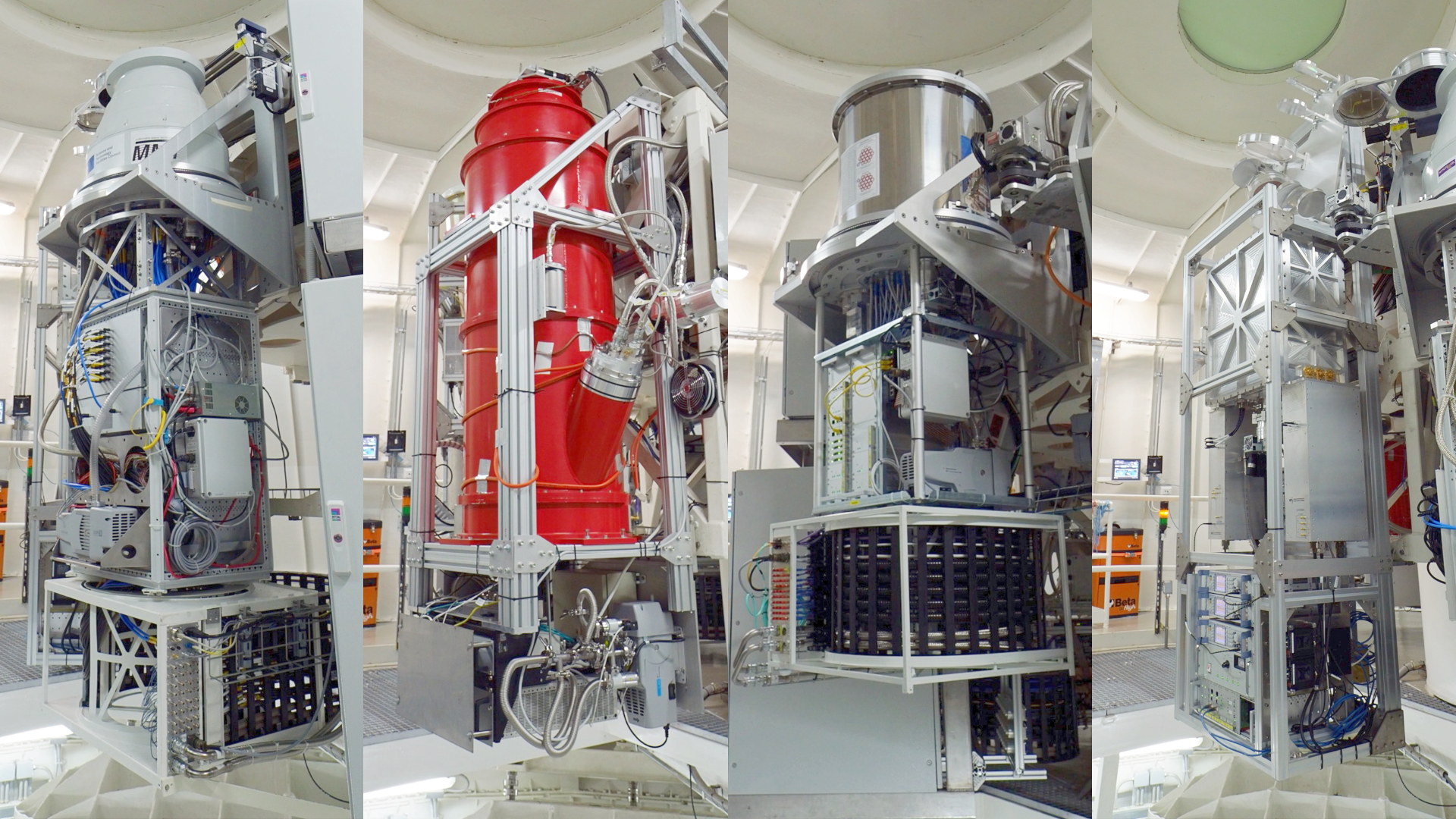
Ongoing instrumentation development
SRT is designed to observe the radio sky up to 116 GHz. It can accommodate up to 20 receivers across six focal positions: the Primary focus, Gregorian focus, and four Beam-Wave Guide foci. Installing new receivers is a key element for expanding the observatory’s scientific capabilities. Eight receivers are currently being installed on SRT, covering frequencies from 300 MHz to 116 GHz. Of these eight, three are currently offered to the scientific community (include a link to “Offered instrumentation”).
The new receivers are in the commissioning phase and were funded by the Italian National Operational Program (PON), which the Italian Ministry of University and Research (MIUR) has recently allocated to INAF. The upgrade aims to enable SRT observations at high radio frequencies. SRT will be ideal for mapping quickly and with relatively high angular resolution extended radio emissions characterized by low surface brightness. It will also be essential for spectroscopic, continuum and polarimetric studies of both Galactic and extragalactic radio sources. These new receivers consist of the following:
The Tri-band (K, Q, and W) receiver has been designed, fabricated, and tested in the laboratories of the Korean Astronomy and Space Institute (KASI), which has experience with the tri-band receiver used for the Korean VLBI Network (KVN). The new tri-band receiver is optimized to meet INAF requirements (see Bolli et al. 2023). It consists of a simultaneous microwave compact triple-band system installed on three Italian radio telescopes (SRT, Medicina, and Noto). The three cryogenic microwave receivers will operate simultaneously in the K/Q/W bands (18–26 GHz, 34–50 GHz, 80–116 GHz), enabling the measurement of tropospheric water-vapor phase fluctuations near 22 GHz and then the application of the corrective term at higher frequencies using the frequency phase transfer (FPT) technique. Using the same receiver type across the three Italian antennas will reinforce SRT’s role within both the Italian and European VLBI networks.
The Q-band receiver has been fully designed and developed at INAF. It is a cryogenic, 19-beam instrument operating in the 33–50 GHz band, consisting of 19 dual-circular-polarization beams arranged in a hexagonal lattice. The receiver therefore provides 38 circular polarizations output signals, each with a 1.6 GHz bandwidth. This receiver is well suited for surveying large areas of the sky in radio continuum emission and in broadband spectro-polarimetry.
The Caruso (W-band) receiver is a 16-beam cryogenic instrument operating in the 70–116 GHz range, comprising 16 dual-linear-polarization beams (see Navarrini et al. 2022). The preliminary design concept for the 4 × 4 (square lattice) W-band receiver was developed by INAF, while its realization was carried out by UK Research and Innovation (UKRI). The angular resolution (HPBW) at 93 GHz is 12 arcsec, and the angular separation between the adjacent feeds is 43 arcsec. The receiver is mounted on a mechanical derotator to maintain the parallactic angle during source tracking. This receiver is essential for continuum and molecular spectral-line studies of astronomical sources, as well as for observing the radio emission from the Sun at 3 mm.
The MISTRAL (MIllimeter Sardinia radio Telescope Receiver based on Array of Lumped elements kids) receiver is a bolometric millimetre camera for the SRT operating in the 77–103 GHz band at 205 mK. This cryogenic camera, built at Sapienza University (Italy), comprises an array of 415 pixels that sample a wide field of view simultaneously (see D’Alessandro et al. 2022). It achieves an angular resolution of about 12 arcsec over a 4 arcmin field of view and is well suited for the study of Sunyaev Zel’dovich effect in galaxy clusters and filaments, spectral energy distribution of external galaxies and surveys of star forming regions.
To reach a maximum frequency of 116 GHz, the radio telescope must achieve a pointing precision of about 1 arcsec and a primary-mirror surface accuracy of about 150 μm (RMS, relative to the ideal profile), corresponding to about λ/20 in the W band. These goals can be attained with a sophisticated measurement and control system for the active surface of the primary reflector and the overall mechanical structure of the telescope. To this end, SRT is being equipped with a metrology system to optimize pointing and gain of the antenna across all elevations. The advanced tools comprising sensor networks (thermal sensors, inclinometers, accelerometers and anemometers), Etalon Absolute Multiline Technology, laser tracker and holographic systems reference antenna allow the development of an open-loop scheme for the errors control and mitigation (Attoli et al. 2023).
The active surface of the primary reflector and the sub-reflector can be continuously adjusted in near real time using look-up tables (LUTs). The metrology system will provide fine calibration of the LUTs, enabling correction of systematic effects due to gravity and compensation for non-systematic effects due to thermal variations.
During the PON works, the coaxial-feed L-P receiver (Valente et al. 2021) was upgraded and is not yet available. It consists of a cryogenic instrument for the SRT primary focus. It simultaneously covers 305–410 MHz (P-Band) and 1.3–1.8 GHz (L-Band). The bandwidth was adjusted based on astronomer requests and radio frequency interference measurements. The LP-Band receiver can observe the same target in two bands simultaneously, enabling precise ionospheric-dispersion analysis and enhancing pulsar survey observations. The polarization is linear but it can be converted to circular (LHCP and RHCP) via a hybrid converter.
Additionally, two new receivers are currently in design and development: a C-band (3.0–7.7 GHz; Maxia et al. 2025) phased array feed (PAF) and an S-band receiver (3–4.5 GHz; Pisanu et al. 2025).
The C-band PAF will be installed in the SRT focal plane and will significantly enhance mapping efficiency by increasing the instantaneous field of view, improving high-resolution observations and enhancing sky sampling capabilities. This will enable studies of galactic gas, magnetic fields, and cosmological surveys. It will consist of a 8 × 8 array of 64 dual-polarized unit cells, resulting in a total of 128 radiating elements.
The cryogenic S-band receiver is being developed at the Observatory of Cagliari and will be installed at SRT’s primary focus. It comprises seven linearly polarized feed horns arranged in a regular hexagonal layout with a central element. This receiver will support studies of pulsars, the Sun, supernova remnants, as well as investigations of the early universe.
| SRT | Frequency Range (GHz) | T_sys (K) | HPBW (arcmin) | State |
|---|---|---|---|---|
| L-P band | 0.310 - 0.410 | 50 | 47 | |
| 1.3 - 1.8 | 35 | 11 | ||
| S-band | 3 - 4.5 | |||
| Q-band | 33 - 50 | 50 - 120 | 0.57 | |
| Tri-band | 18 - 26 | 80 - 110 | 1 | |
| 34 - 50 | 83 - 141 | 0.57 | ||
| 80 - 116 | 166 - 252 | 0.22 | ||
| CARUSO | 80 - 116 | 80 | 0.22 | |
| MISTRAL | 77 - 103 |