Offered instrumentation
The Sardinia Radio Telescope offers a diverse suite of state-of-the-art instrumentation, enabling observations across a wide radio frequency range and supporting a broad science program. Proposers can submit single-dish proposals and extra-EVN interferometry proposals that combine SRT with other Italian antennas and international facilities. Proposers can request specific receiver bands, backend configurations, and observing modes to match their science goals.
The control software produced for SRT is named DISCOS, a distributed system based on ALMA Common Software (ACS), commanding all the devices of the telescope and allowing the user to perform radio astronomy observations. The observers will follow a short training at their arrival in order to learn how to perform the observations. The User Cookbook is intended to support the observer when performing observations with SRT, given step by step the commands to follow. The observers can find the complete documentation on the user guide: Observing at SRT with Discos. For the data analysis, the observers can use: - SDT: Single-dish tools for the continuum analysis (Bachetti). - d2c-GUI data converter station’s software to convert data recorded by the SRT into a format suitable to CLASS, one of the software packages which belongs to GILDAS.
Receivers
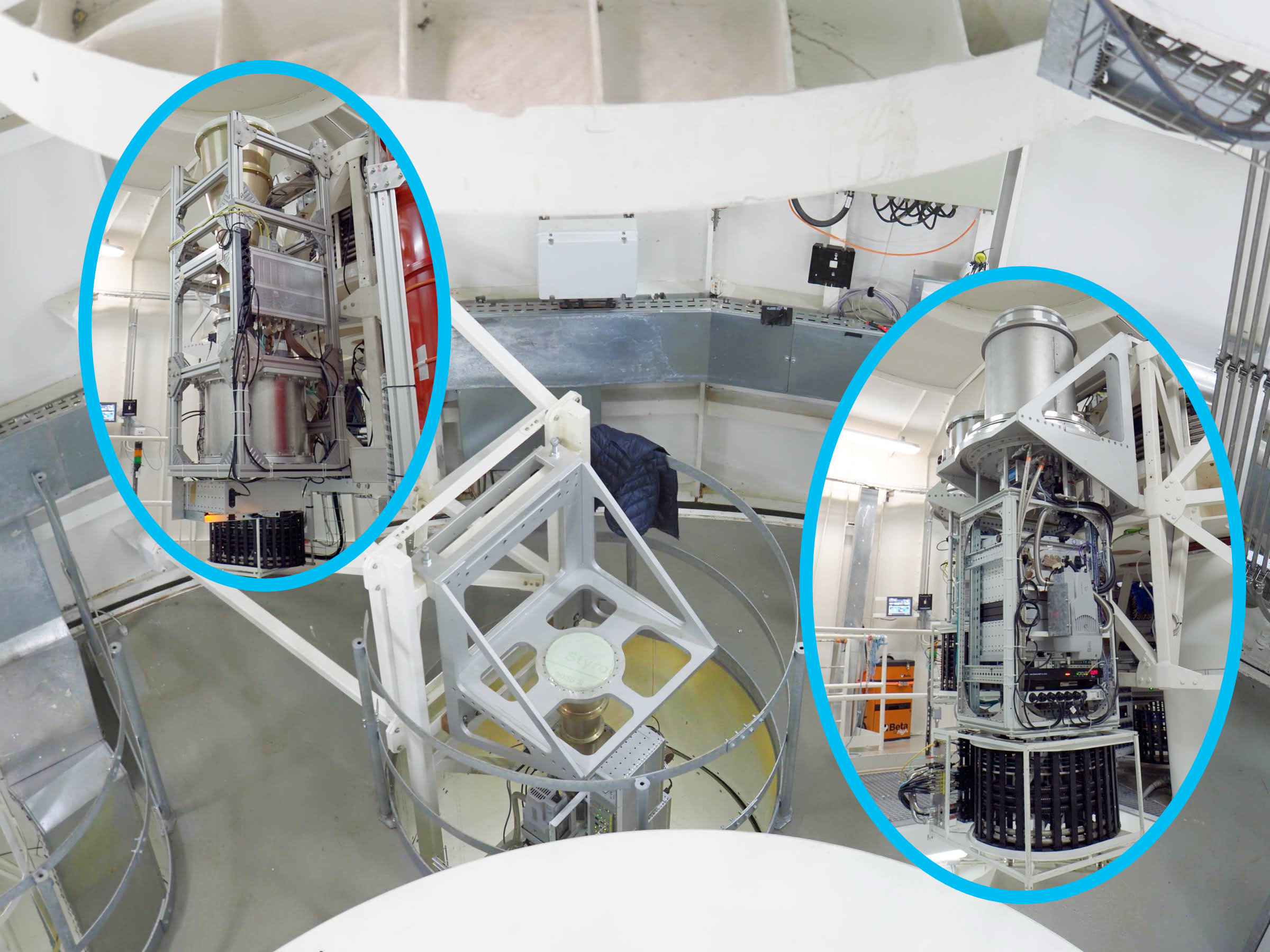
In this call for proposals, the available receivers are the C-low (4.2–5.6 GHz), C-high (5.7–7.7 GHz), and K-band (18–26.5 GHz), enabling continuum, spectro-polarimetric, spectral-line and timing observations. These receivers are installed at different focal positions, which are supported by a sophisticated system that uses a shaped Gregorian optical configuration with a 64-m primary reflector and a 7.9-m secondary reflector. The receivers are remotely selectable, meaning that a receiver can be moved into its focal position within a few minutes. This system allows for quick and efficient changes between different observational frequencies.
The C-low is a single-feed cryogenic receiver that allows the processing of signals in circular polarization (LHCP and RHCP) within the frequency range from 4.2 to 5.6 GHz. This receiver is installed on the Gregorian focus of SRT and requires the shaped configuration of the active surface. To analyze the entire frequency band ranging from 4.2 to 5.6 GHz and shift it down to baseband, the local oscillator must be set to 4.2 GHz. However, due to a presence of strong RFI at the end of the band, it is possible to set the local oscillator at 4.6 GHz and a bandwidth of 300 MHz (available on DISCOS functions) to have a free-of-RFI band. A detailed description of the C-low band RFI scenario is provided in the following paper: Schirru et. al, Sensors, 24(19), 6481 (2024).
The C-high (or M-band) receiver is a mono-feed cryogenic system that allows the processing of signals in circular polarization (LHCP and RHCP) within the frequency range from 5.7 to 7.7 GHz. This receiver is installed in one of the Beam-Wave Guide focal points of SRT and requires the shaped configuration of the active surface.
The K-band is a cryogenic, multi-feed receiver that enables circular polarization measurement (LHCP and RHCP) over a frequency range of 18 to 26.5 GHz. It consists of seven identical receiver chains. This multi-feed configuration increases the mapping speed for extended radio sources compared with a single-feed system. The focal-plane array is arranged hexagonally: six feeds lie at the vertices of the hexagon, with a seventh feed at the centre. This geometry provides full Nyquist sampling of the sky. To compensate for the relative rotation between the Earth and the celestial sphere during long observations (OTF/raster mapping or sidereal tracking), the receiver is equipped with a rotating dewar. Installed on the Gregorian focus of SRT, it requires the shaped configuration of the active surface.
| SRT | Frequency Range (GHz) | T_sys (K) | HPBW (arcmin) |
|---|---|---|---|
| C-low | 4.2 - 5.6 | 25 | 4.2 |
| C-high | 5.7 - 7.7 | 35 | 2.9 |
| K-band | 18 - 26.5 | 50 - 100 | 0.75 - 1 |
Backends
SRT is currently equipped with a variety of backends, each of which is dedicated to a specific observing mode depending on its capabilities in terms of bandwidth, spectral and temporal resolution: Total Power, SARDARA, SKARAB, DFB, DBBC2 and DBBC3.
The Total Power (TP; Scalambra et al. 2013) is a single-band backend for continuum observations. Located just below the dish, this backend is formed by 14 voltage-to-frequency converters that digitize the incoming RF signals. Each of the 14 sections processes a single IF channel with a single polarization, as input. The nominal IF band is 2 GHz (0.1-2.1 GHz). On-board filters can restrict the band to 250, 680, or 1200 MHz. The same boards also perform the focus selection for the SARDARA backend. The sampling time can be set from 1 ms to 1 s.
SARDARA (SArdinia Roach2-based Digital Architecture for Radio Astronomy) is a flexible digital backend with a fully reconfigurable architecture, designed to support a wide range of observing modes for single-dish radio telescopes, including continuum, polarimetry, high-frequency resolution spectroscopy (the total bandwidth can be split into 16,384 channels), and high-time-resolution observations for pulsars and fast transients (not currently available). It is composed of seven ROACH2 boards, and can analyse up to 14 signals of 2 GHz each (Melis et al. 2018) in order to fully exploit the seven-feed K-band receiver. SARDARA’s spectral resolution and sensitivity are defined by its full 1500 MHz bandwidth. However only 1200 MHz of the full 1500 MHz bandwidth is usable, since the 1200 MHz filter of the Total Power backend’s Focus Selector is being used as input to SARDARA. The sampling time can be set from 5ms to 1 s. It is the backend of choice for On-The-Fly (OTF) spectro-polarimetric observations. The available configurations are 420 or 1500 MHz bandwidth with 1024 or 16384 channels.
SKARAB (Square Kilometer Array Reconfigurable Application Board) is a digital FPGA-based platform that represents the next generation of the ROACH2. Conceptualized by the Square Kilometer Array South Africa (SKA-SA), SKARAB displays promising performance in all the observation modes proposed for SRT single-dish observations (Melis et al. 2024) thanks to its very high dynamic range, high-frequency resolution and high-resolution timing (not currently available). SKARAB enables two 1400 MHz input signals to be digitized and processed and provides four spectra with 2048 channels, suitable for spectral–polarimetric imaging applications. Its sampling time can be set from 5ms to 1 s. It is the backend of choice for On-The-Fly (OTF) spectro-polarimetric observations. The available bandwidths are: 16, 20, 23, 32, 40, 46.875, 64, 80, 93.75, 128, 160, 187.5, 1400 MHz. Each band can be divided in 65536, 32768 or 2048 frequency bins for full Stokes configurations.
DFB3 is an FX correlator developed by the Australia Telescope National Facility (ATNF) that performs full-Stokes observations. It allows for four inputs, each with a 1024 MHz maximum bandwidth and 8-bit sampling for a high dynamic range. The DFB3 is suitable for precise pulsar timing and searching. It allows for up to 8192 spectral channels in order to counter the effects of interstellar dispersion. At SRT, DFB3 observations are piloted using the SEADAS software (Corongiu et al. 2014).
DBBC2 (Digital Base Band Converter 2) is a digital platform based on a flexible architecture composed of four ADC boards, with 1 GHz of bandwidth each and four Xilinx FPGA boards for data processing. The platform is designed mainly for VLBI experiments; however, a wideband spectrometer has been developed for other purposes.
DBBC3 (Digital Base Band Converter 3) is a platform developed specifically for VLBI (interferometry). This third generation of DBBC backend is able to fully implement digitally all the functionality required of a complete 32 Gbps VLBI backend for the EVN. It will be used for the new tri-band (K, Q, W) receiver, which has been recently installed at SRT and is under commissioning. Further details on the receivers and backends offered for the call of proposal are here.
Software
The control software produced for SRT is named DISCOS, a distributed system based on ALMA Common Software (ACS), commanding all the devices of the telescope and allowing the user to perform radio astronomy observations. The observers will follow a short training at their arrival in order to learn how to perform the observations.
The User Cookbook is intended to support the observer when performing observations with SRT, given step by step the commands to follow. The observers can find the complete documentation on the user guide: Observing at SRT with Discos.
For the data analysis, the observers can use:
- SDT: Single-dish tools for the continuum analysis (Bachetti).
- d2c-GUI data converter station’s software to convert data recorded by the SRT into a format suitable to CLASS, one of the software packages which belongs to GILDAS.