
SPARCS-North Wide-field VLBI Survey: exploring the resolved μJy extragalactic radio source population with EVN + e-MERLIN
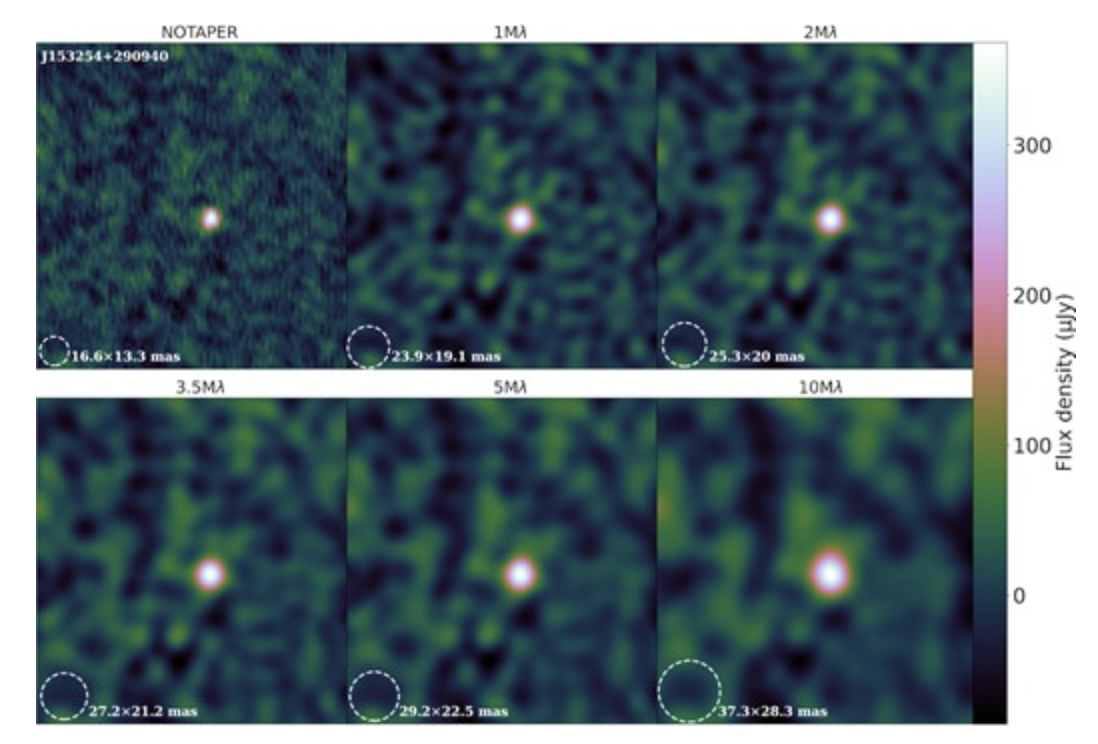
The SKA PAthfinder Radio Continuum Surveys (SPARCS) are providing deep-field imaging of the faint (sub-mJy) extragalactic radio source populations through a series of reference surveys. One of the key science goals for SPARCS is to characterize the relative contribution of radio emission associated with active galactic nucleus (AGN) from star formation (SF) in these faint radio source populations, using a combination of high sensitivity and high angular resolution imaging over a range of spatial scales (arcsec to mas). To isolate AGN contribution from SF, we hypothesize that there exists a brightness temperature cut-off point separating pure AGN from SF. We present a multiresolution (10-100 mas) view of the transition between compact AGN and diffuse SF through a deep wide-field EVN + e-MERLIN, multiple phase centre survey of the centre of the Northern SPARCS (SLOAN) reference field at 1.6 GHz. This is the first (and only) VLBI (+ e-MERLIN) milliarcsecond angular resolution observation of this field, and of the wider SPARCS reference field programme. Using these high spatial resolution (9 pc-0.3 kpc at z ~ 1.25) data, 11 milliarcsec-scale sources are detected from a targeted sample of 52 known radio sources from previous observations with the e-MERLIN, giving a VLBI detection fraction of 21%. At spatial scales of 9 pc, these sources show little to no jet structure whilst at 0.3 kpc one-sided and two-sided radio jets begin to emerge on the same sources, indicating a possible transition from pure AGN emissions to AGN and SF systems.
Published in Monthly Notices of the Royal Astronomical Society, Volume 519, Issue 2, pp.1732-1744