
Exploring Coronal Holes Through K-Band Radio Observations (18-26 GHz) with INAF Radio Telescopes
Coronal holes (CHs) are low-density regions in the solar atmosphere, characterised by open magnetic field lines driving the high-speed solar wind. While appearing dark in EUV/X-rays, their radio signatures are complex and frequency-dependent, showing either brightness depressions or enhancements relative to the quiet-Sun (QS). This variability reflects the complex inner temperature, density and magnetic structures of the solar atmosphere.
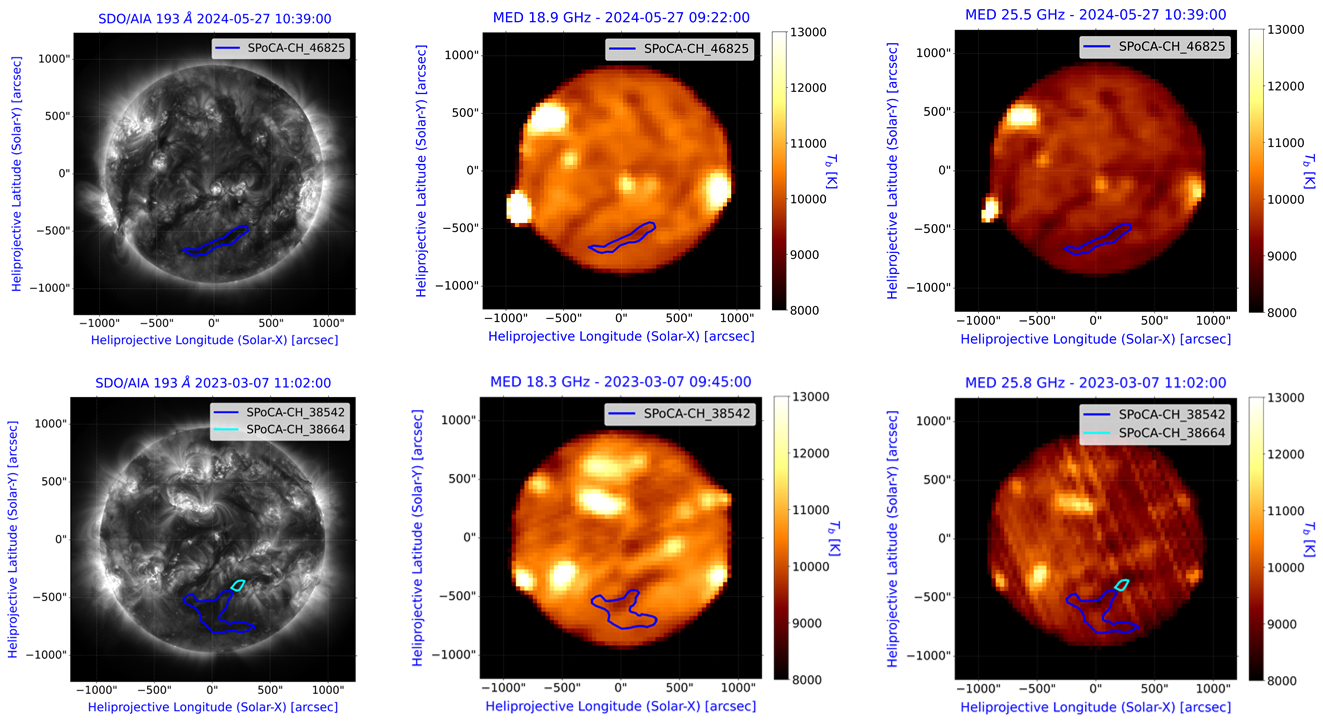
Within the SunDish project, we investigate the CH phenomenology using the National Institute for Astrophysics (INAF) large single-dish radio telescopes (Medicina ‘Gavril Grueff’ 32-m and Sardinia Radio Telescope ‘SRT’ 64-m), aiming to bridge the observational gap between the chromosphere and corona by exploring the under-investigated K-band (18 – ). This study analyses three representative scenarios: expected brightness temperature ( ) depressions, radio-enhanced CHs, and radio-dark regions (RDRs) unrelated to standard CHs.
Our analysis reveals a non-uniform phenomenology where radio-enhanced CHs and RDRs identify deep-penetrating structures affecting the upper chromosphere, including the first radio counterpart to a dark halo. Spectral indices and weak circular polarisation confirm thermal free-free emission as the primary mechanism, excluding significant gyro-magnetic contributions. However, magnetic field estimates suggest that a purely thermal model in a simple stratified atmosphere cannot fully describe these regions, where radio enhancements likely arise from unresolved structures like coronal bright points and magnetic flux tubes. These results highlight multi-frequency diagnostics as an essential tool for probing the coupling between different layers of the solar atmosphere, demonstrating that CHs are dynamic environments where complex magnetic activity drives their vertical structure and evolution.
Published in Solar Physics, 301, 117, 2026