
A Keplerian disk with a four-arm spiral birthing an episodically accreting high-mass protostar
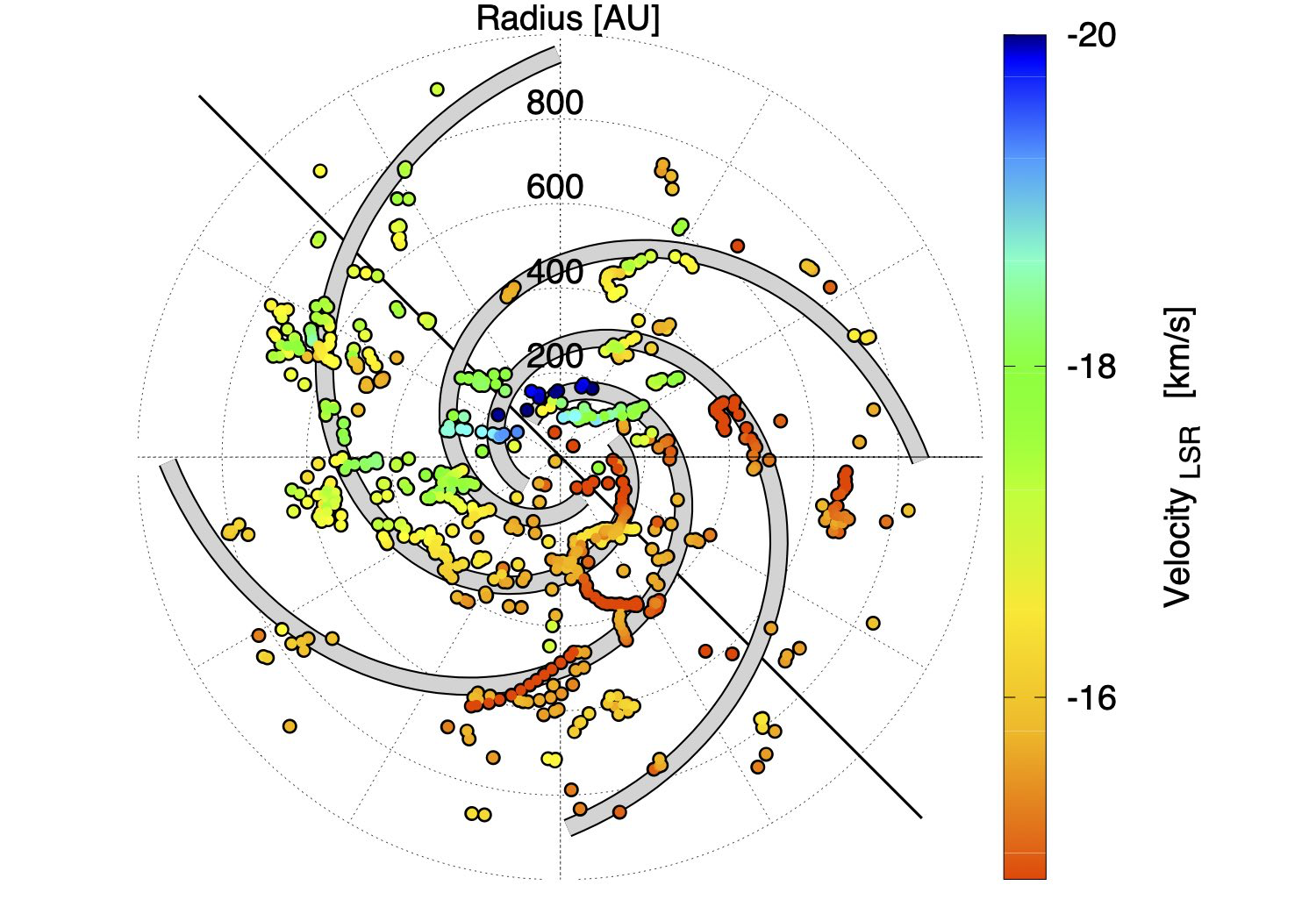
High-mass protostars are thought to gain the majority of their mass via short, intense bursts of growth. This episodic accretion is thought to be facilitated by gravitationally unstable and subsequently inhomogeneous accretion disks. Limitations of observational capabilities, paired with a lack of observed accretion burst events, have withheld affirmative confirmation of the association between disk accretion, instability and the accretion burst phenomenon in high-mass protostars. Following its 2019 accretion burst, a heatwave driven by a burst of radiation propagated outward from the high-mass protostar G358.93-0.03-MM1. Six very long baseline interferometry observations of the radiatively pumped 6.7 GHz methanol maser were conducted during this period, tracing ever increasing disk radii as the heatwave propagated outward. Concatenating the very long baseline interferometry maps provided a sparsely sampled, milliarcsecond view of the spatio-kinematics of the accretion disk covering a physical range of ~50–900 AU. We term this observational approach ‘heatwave mapping’. We report the discovery of a Keplerian accretion disk with a spatially resolved four-arm spiral pattern around G358.93-0.03-MM1. This result positively implicates disk accretion and spiral arm instabilities into the episodic accretion high-mass star formation paradigm.
Published in Nature Astronomy, Volume 7, pages 557–568