
The Fast Radio Burst FRB 20201124A in a star forming region: constraints to the progenitor and multiwavelength counterparts
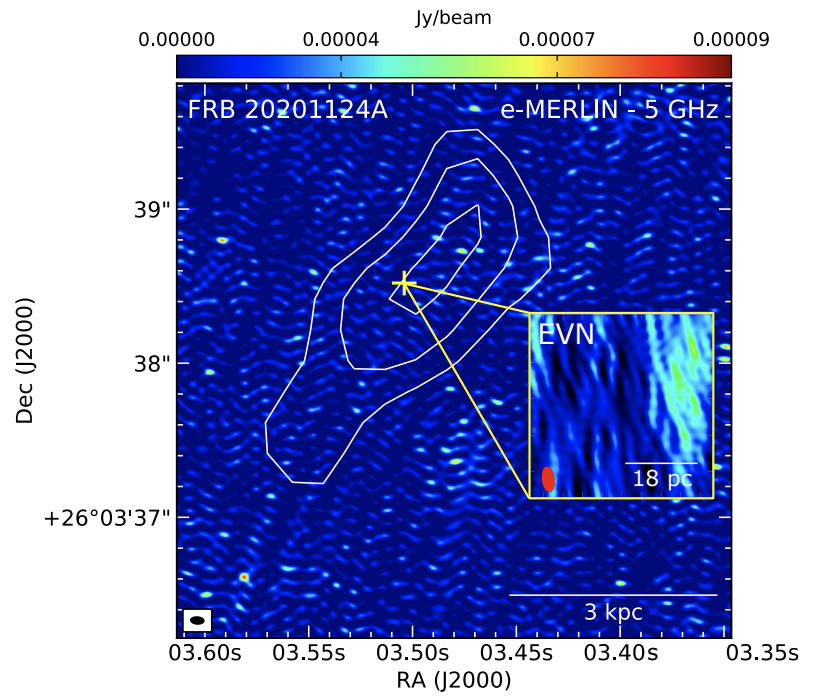
We present the results of a multiwavelength campaign of FRB 20201124A, the third closest repeating fast radio burst recently localized in a nearby (z = 0.0978) galaxy. Deep VLA observations led to the detection of quiescent radio emission, also marginally visible in X-rays with Chandra. Imaging at 22 GHz allowed us to resolve the source on a scale of > 1" and locate it at the position of the FRB, within an error of 0.2". EVN and e-MERLIN observations sampled small angular scales, from 2 to 100 mas, providing tight upper limits on the presence of a compact source and evidence for diffuse radio emission. We argue that this emission is associated with enhanced star formation activity in the proximity of the FRB, corresponding to a star formation rate of ≈ 10 M yr^−1 . The surface star formation rate at the location of FRB 20201124A is two orders of magnitude larger than typically observed in other precisely localized FRBs. Such a high SFR is indicative of this FRB source being a new-born magnetar produced from a SN explosion of a massive star progenitor. Upper limits to the X-ray counterparts of 49 radio bursts observed in our simultaneous FAST, SRT and Chandra campaign are consistent with a magnetar scenario.
Published in Astronomy & Astrophysics, Volume 656, id.L15, 11 pp.