
Multiwavelength flare observations of the blazar S5 1803+784
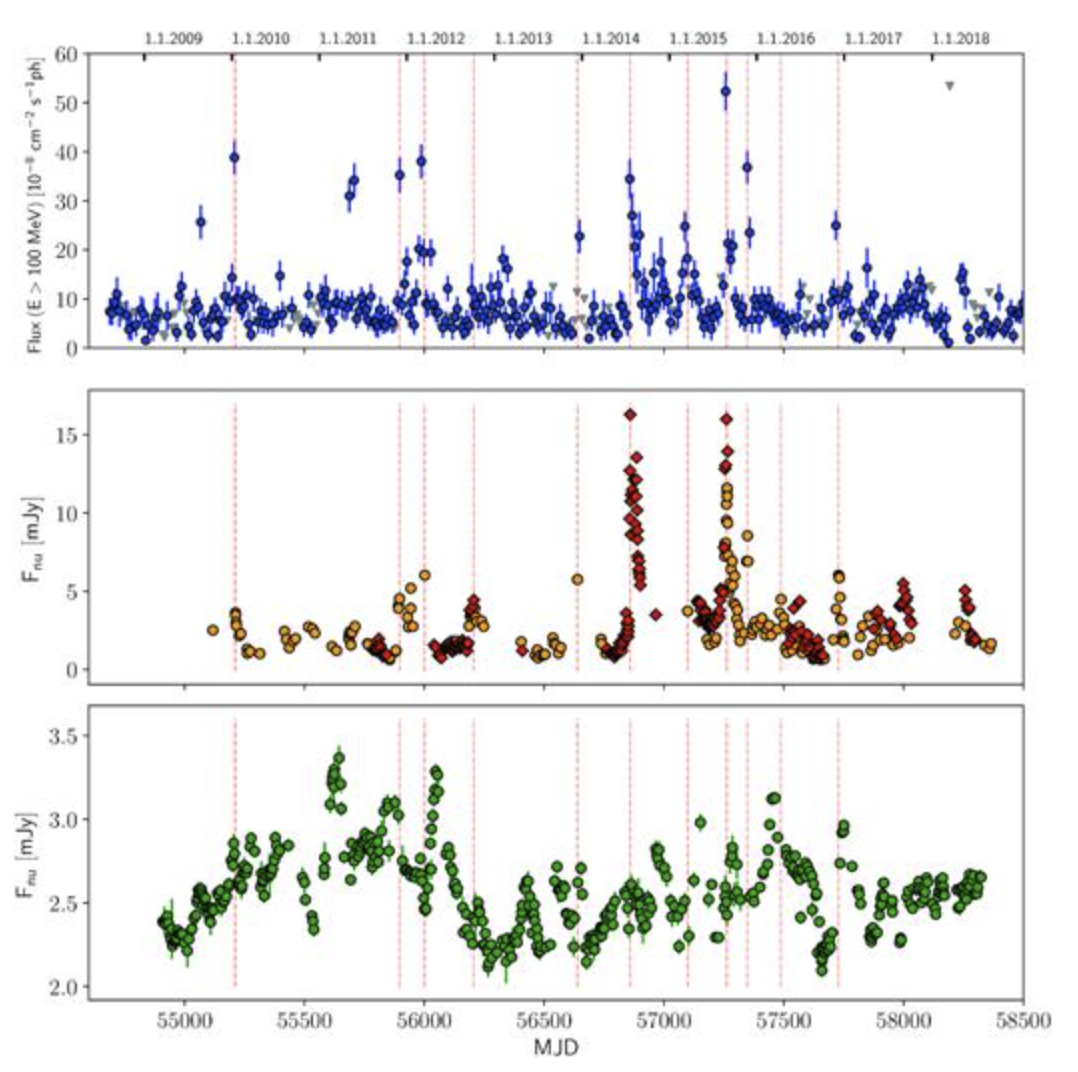
The radio, optical, and γ-ray light curves of the blazar S5 1803+784, from the beginning of the Fermi-Large Area Telescope (LAT) mission in 2008 August-2018 December, are presented. The aim of this work is to look for correlations among different wavelengths useful for further theoretical studies. We analysed all the data collected by Fermi-LAT for this source, taking into account the presence of nearby sources, and we collected optical data from our own observations and public archive data to build the most complete optical and γ-ray light curve possible. Several γ-ray flares (F > 2.3 10-7ph(E > 0.1 GeV) cm-2 s-1) with optical coverage were detected, all but one with corresponding optical enhancement; we also found two optical flares without a γ-ray counterpart. We obtained two Swift Target of Opportunity observations during the strong flare of 2015. Radio observations performed with VLBA and EVN through our proposals in the years 2016-2020 were analysed to search for morphological changes after the major flares. The optical/γ-ray flux ratio at the flare peak varied for each flare. Very minor optical V - I colour changes were detected during the flares. The X-ray spectrum was well fitted by a power law with photon spectral index α = 1.5, nearly independent of the flux level: No clear correlation with the optical or the γ-ray emission was found. The radio maps showed two new components originating from the core and moving outwards, with ejection epochs compatible with the dates of the two largest γ-ray flares.
Published in Monthly Notices of the Royal Astronomical Society, Volume 502, Issue 4, pp.6177-6187