
The New Magnetar SGR J1830-0645 in Outburst
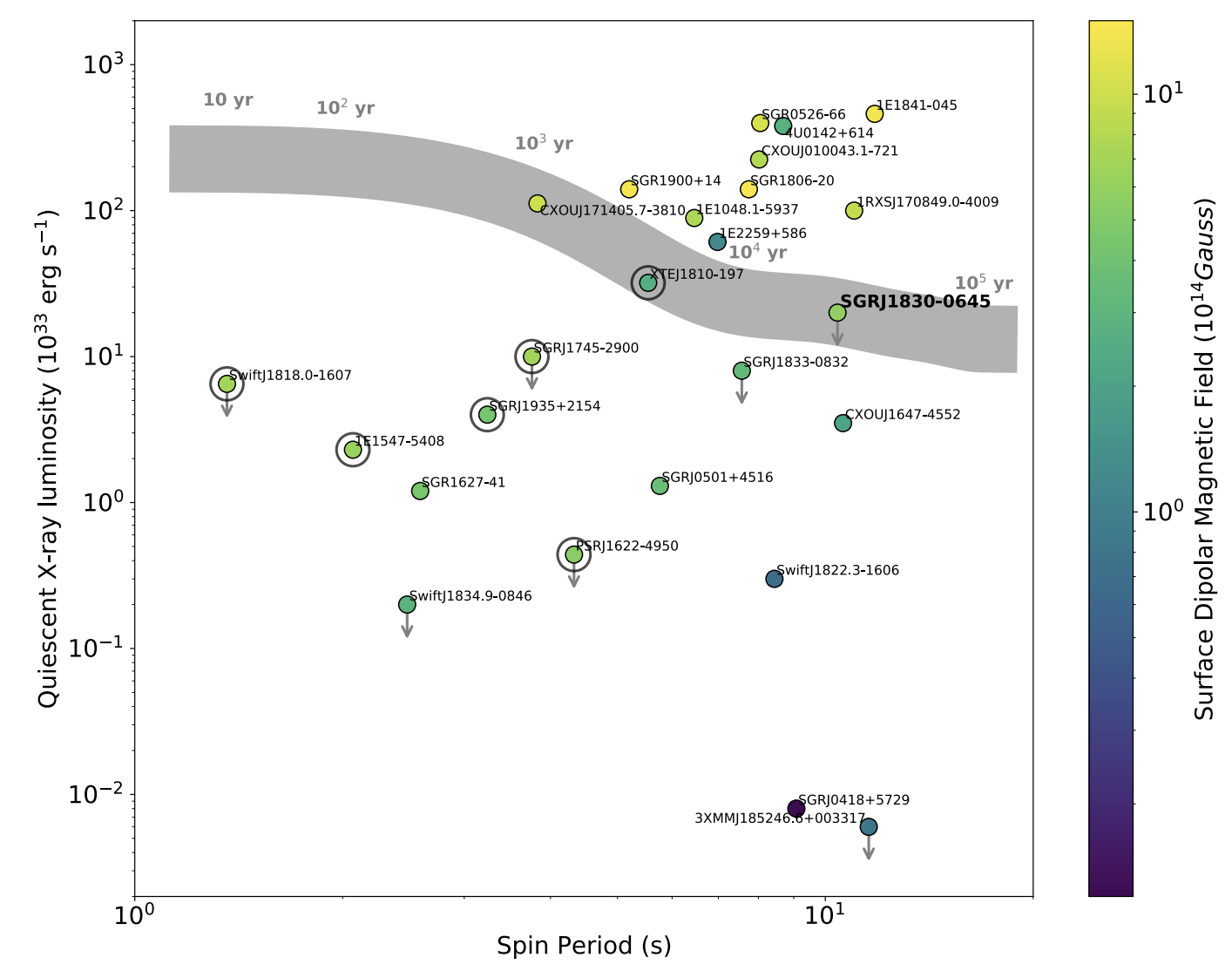
The detection of a short hard X-ray burst and an associated bright soft X-ray source by the Swift satellite in 2020 October heralded a new magnetar in outburst, SGR J1830−0645. Pulsations at a period of ∼10.4 s were detected in prompt follow-up X-ray observations. We present here the analysis of the Swift/BAT burst, of XMM-Newton and the Nuclear Spectroscopic Telescope Array observations performed at the outburst peak, and of a Swift/XRT monitoring campaign over the subsequent month. The burst was single-peaked, lasted ∼6 ms, and released a fluence of ≈ 5 × 10^−9 erg cm^−2 (15–50 keV). The spectrum of the X-ray source at the outburst peak was well described by an absorbed double-blackbody model plus a power-law component detectable up to ∼25 keV. The unabsorbed X-ray flux decreased from ∼ 5 × 10^−11 to ∼ 2.5 × 10^−11 erg cm^−2 s^−1 one month later (0.3–10 keV). Based on our timing analysis, we estimate a dipolar magnetic field ≈ 5.5 × 10^14 G at pole, a spin-down luminosity ≈ 2.4 × 10^32 erg s^−1 , and a characteristic age ≈24 kyr. The spin modulation pattern appears highly pulsed in the soft X-ray band, and becomes smoother at higher energies. Several short X-ray bursts were detected during our campaign. No evidence for periodic or single-pulse emission was found at radio frequencies in observations performed with the Sardinia Radio Telescope and Parkes. According to magnetothermal evolutionary models, the real age of SGR J1830−0645 is close to the characteristic age, and the dipolar magnetic field at birth was slightly larger, ∼10^15 G.
Published in The Astrophysical Journal Letters, Volume 907, Issue 2, id.L34, 9 pp.