
A parsec-scale faint jet in the nearby changing-look Seyfert galaxy Mrk 590
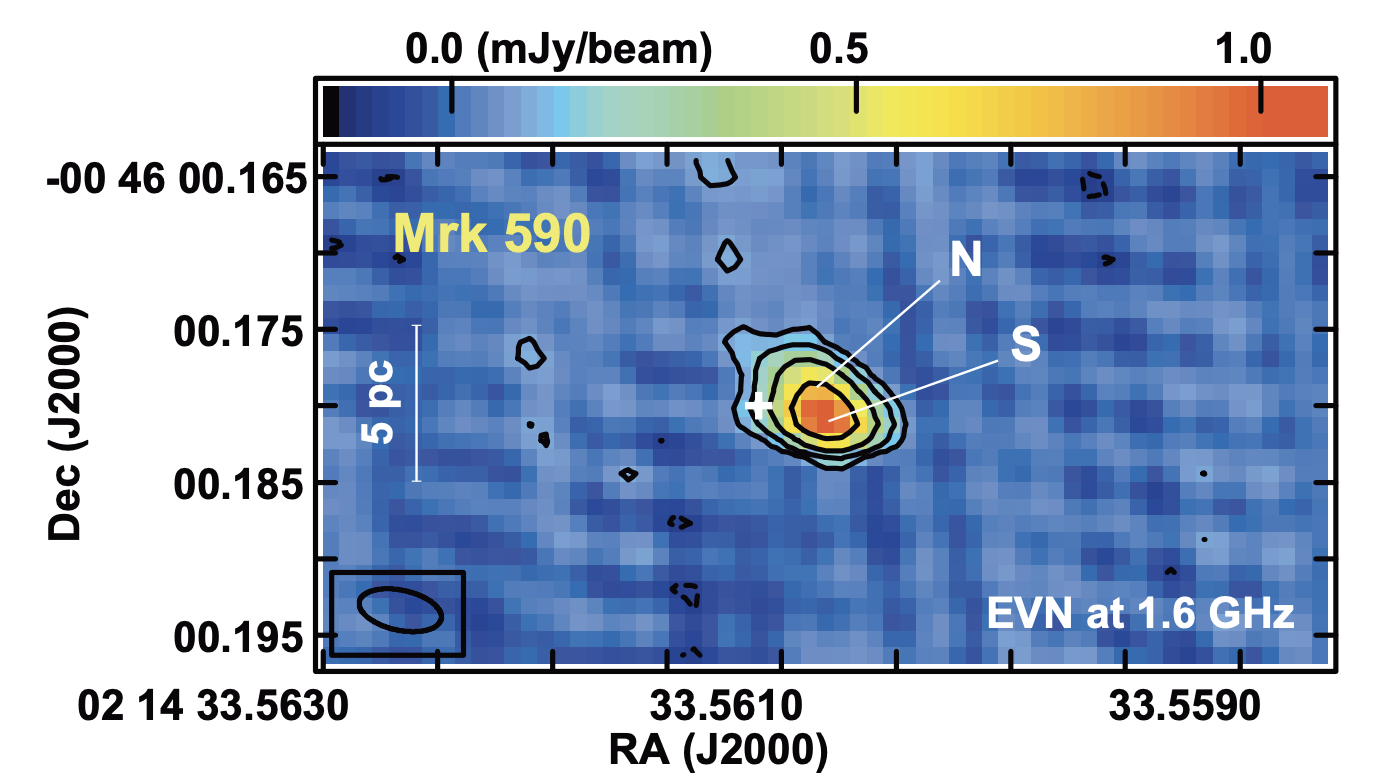
Broad Balmer emission lines in active galactic nuclei (AGN) may display dramatic changes in amplitude, even disappearance and re-appearance in some sources. As a nearby galaxy at a redshift of 𝑧 = 0.0264, Mrk 590 suffered such a cycle of Seyfert type changes between 2006 and 2017. Over the last fifty years, Mrk 590 also underwent a powerful continuum outburst and a slow fading from X-rays to radio wavelengths with a peak bolometric luminosity reaching about ten per cent of the Eddington luminosity. To track its past accretion and ejection activity, we performed very long baseline interferometry (VLBI) observations with the European VLBI Network (EVN) at 1.6 GHz in 2015. The EVN observations reveal a faint (∼1.7 mJy) radio jet extending up to ∼2.8 mas (projected scale ∼1.4 pc) toward north, and probably resulting from the very intensive AGN activity. To date, such a parsec-scale jet is rarely seen in the known changing-look AGN. The finding of the faint jet provides further strong support for variable accretion as the origin of the type changes in Mrk 590.
Published in Monthly Notices of the Royal Astronomical Society: Letters, Volume 502, Issue 1, pp.L61-L65