
The nearby extreme accretion and feedback system PDS 456: finding a complex radio-emitting nucleus
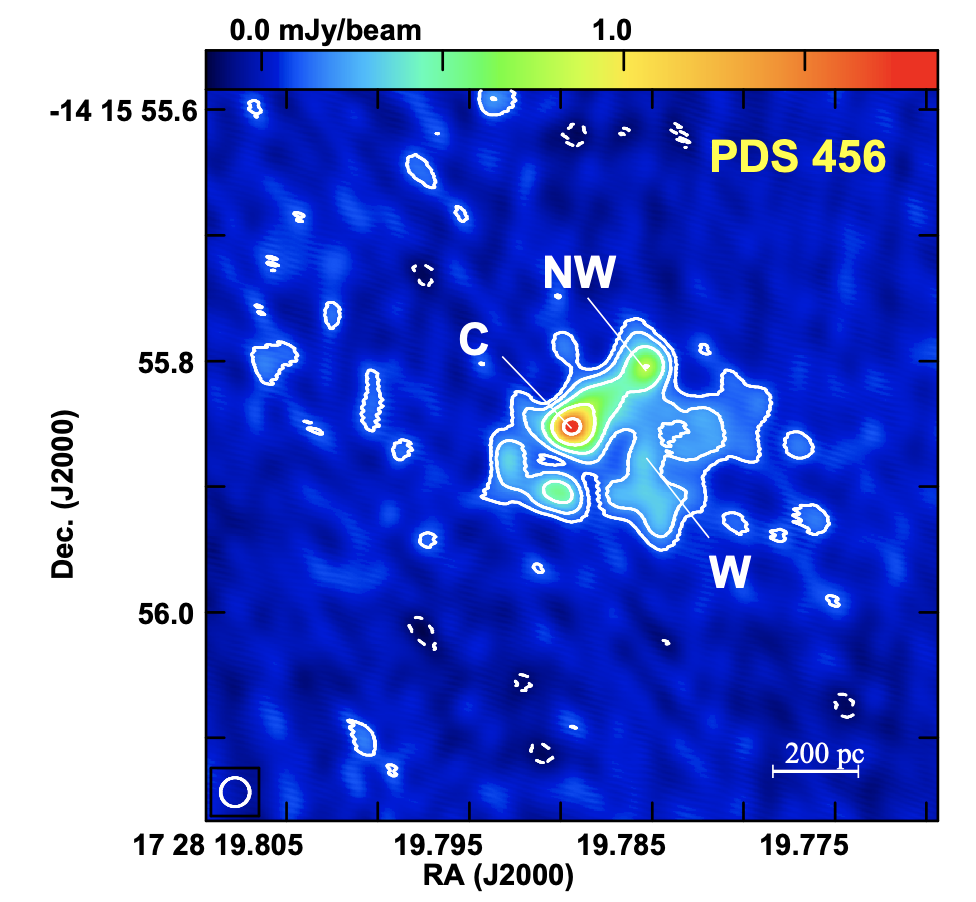
When a black hole accretes close to the Eddington limit, the astrophysical jet is often accompanied by radiatively driven, wide-aperture and mildly relativistic winds. Powerful winds can produce significant non-thermal radio emission via shocks. Among the nearby critical accretion quasars, PDS 456 has a very massive black hole (about one billion solar masses), shows a significant star-forming activity (about seventy solar masses per year) and hosts exceptionally energetic X-ray winds (power up to twenty per cent of the Eddington luminosity). To probe the radio activity in this extreme accretion and feedback system, we performed very-long-baseline interferometric (VLBI) observations of PDS 456 at 1.66 GHz with the European VLBI Network (EVN) and the enhanced Multi-Element Remotely Linked Interferometry Network (e-MERLIN). We find a rarely-seen complex radio-emitting nucleus consisting of a collimated jet and an extended non-thermal radio emission region. The diffuse emission region has a size of about 360 pc and a radio luminosity about three times higher than the nearby extreme starburst galaxy Arp 220. The powerful nuclear radio activity could result from either a relic jet with a peculiar geometry (nearly along the line of sight) or more likely from diffuse shocks formed naturally by the existing high-speed winds impacting on high-density star-forming regions.
Published in Monthly Notices of the Royal Astronomical Society, Volume 500, Issue 2, pp.2620-2626