
Study of solar brightness profiles in the 18-26 GHz frequency range with INAF radio telescopes II. Evidence of coronal emission
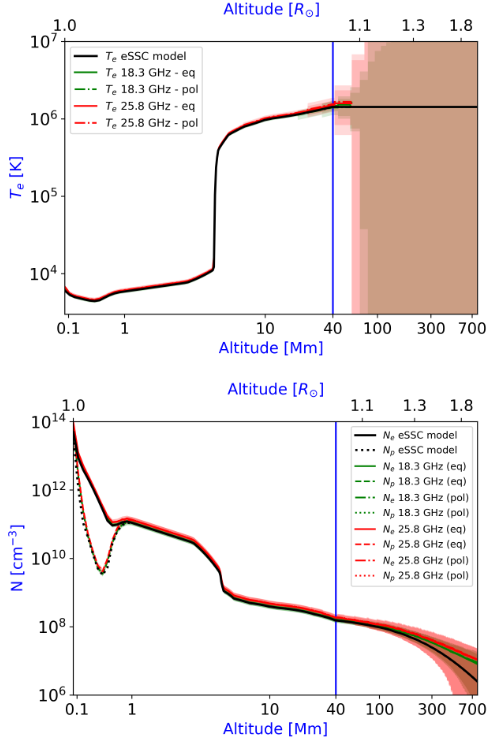
We aim to constrain the temperature (T) and density (N) distributions of the solar atmosphere through observations in the centimetric radio domain. We employed single-dish observations from two of the INAF radio telescopes at the K-band frequencies (18 – 26 GHz). We investigated the origin of the significant brightness temperature (TB) detected up to the upper corona (at an altitude of ∼ 800 Mm with respect to the photospheric solar surface). To probe the physical origin of the atmospheric emission and to constrain instrumental biases, we reproduced the solar signal by convolving specific 2D antenna beam models. We performed an analysis of the solar atmosphere by adopting a physical model that assumes the thermal bremsstrahlung as the emission mechanism, with specific T and N distributions. We compared the modelled TB profiles with those observed by averaging solar maps obtained at 18.3 and 25.8 GHz during the minimum of solar activity (2018 – 2020). We probed any possible discrepancies between the T and N distributions assumed from the model and those derived from our measurements. The T and N distributions are compatible (within a 25% of uncertainty) with the model up to ∼ 60 Mm and ∼ 100 Mm in altitude, respectively. Our analysis of the role of the antenna beam pattern on our solar maps proves the physical nature of the atmospheric emission in our images up to the coronal tails seen in our TB profiles. Our results suggest that the modelled T and N distributions are in good agreement (within 25% of uncertainty) with our solar maps up to altitudes of ∼ 100 Mm. A subsequent, more challenging analysis of the coronal radio emission at higher altitudes, together with the data from satellite instruments, will require further multi-frequency measurements.
Published in Published in Astronomy & Astrophysics, Volume 684, id.A123, 12 pp.