
A Very Young Radio-loud Magnetar
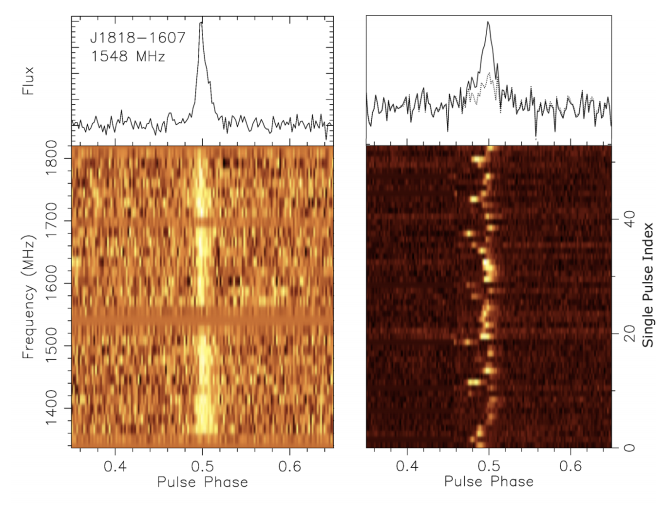
The magnetar Swift J1818.0–1607 was discovered in March 2020 when Swift detected a 9 ms hard X-ray burst and a long-lived outburst. Prompt X-ray observations revealed a spin period of 1.36 s, soon confirmed by the discovery of radio pulsations. We report here on the analysis of the Swift burst and follow-up X-ray and radio observations. The burst average luminosity was ∼ 2 × 10^39 erg/s (at 4.8 kpc). Simultaneous observations with XMM–Newton and NuSTAR three days after the burst provided a source spectrum well fit by an absorbed blackbody plus a power-law (Γ = 0.0 ± 1.3) in the 1–20 keV band, with a luminosity of ∼8×10^34 erg/s, dominated by the blackbody emission. From our timing analysis, we derive a dipolar magnetic field B ∼ 7 × 10^14 G, spin-down luminosity ∼ 1.4 × 10^36 erg/s and characteristic age of 240 yr, the shortest currently known. Archival observations led to an upper limit on the quiescent luminosity <5.5 × 10^33 erg/s, lower than the value expected from magnetar cooling models at the source characteristic age. A 1 hr radio observation with the Sardinia Radio Telescope taken about 1 week after the X-ray burst detected a number of strong and short radio pulses at 1.5 GHz, in addition to regular pulsed emission; they were emitted at an average rate 0.9 /min and accounted for ∼50% of the total pulsed radio fluence. We conclude that Swift J1818.0–1607 is a peculiar magnetar belonging to the small, diverse group of young neutron stars with properties straddling those of rotationally and magnetically powered pulsars. Future observations will make a better estimation of the age possible by measuring the spin-down rate in quiescence.
Published in The Astrophysical Journal Letters, Volume 896, Issue 2, id.L30, 8 pp.