
Simultaneous multi-telescope observations of FRB 121102
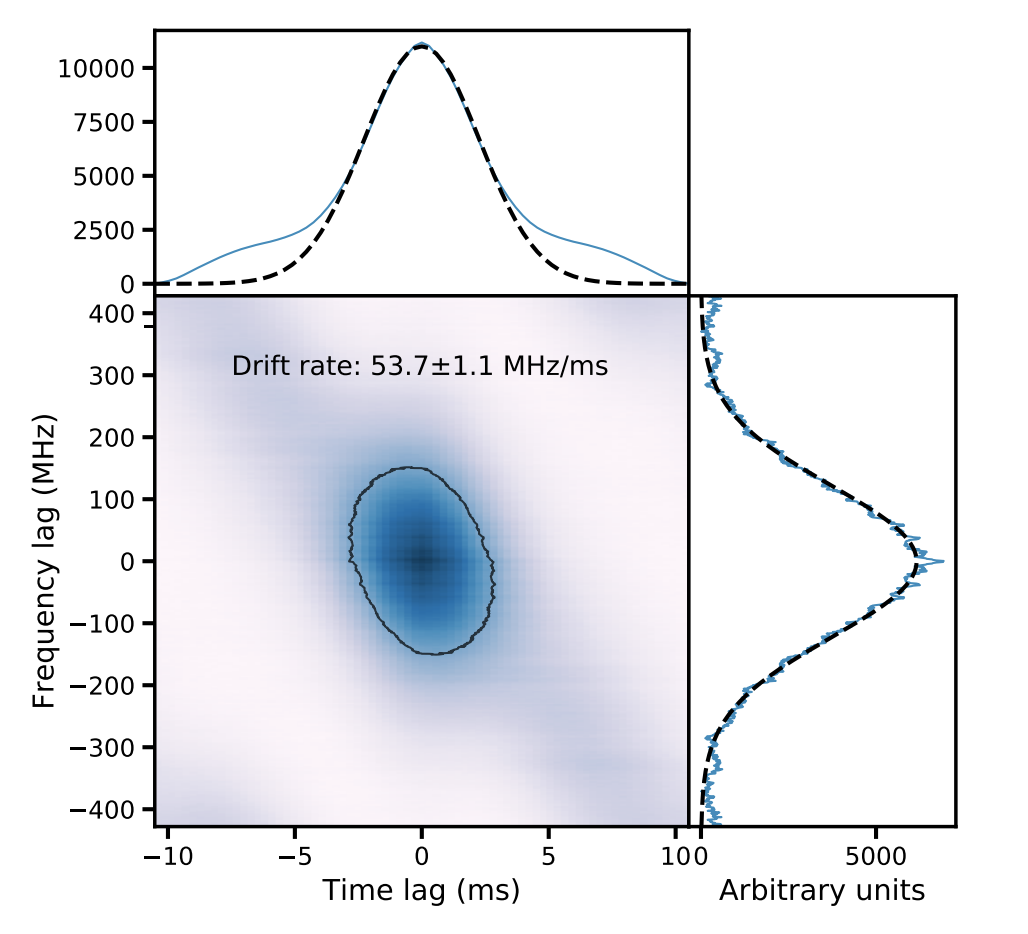
We present 11 detections of FRB 121102 in ∼3 h of observations during its 'active' period on the 10th of 2019 September. The detections were made using the newly deployed MeerTRAP system and single pulse detection pipeline at the MeerKAT radio telescope in South Africa. Fortuitously, the Nançay radio telescope observations on this day overlapped with the last hour of MeerKAT observations and resulted in four simultaneous detections. The observations with MeerKAT's wide band receiver, which extends down to relatively low frequencies (900-1670 MHz usable L-band range), have allowed us to get a detailed look at the complex frequency structure, intensity variations, and frequency-dependent sub-pulse drifting. The drift rates we measure for the full-band and sub-banded data are consistent with those published between 600 and 6500 MHz with a slope of −0.147 ± 0.014 m/s. Two of the detected bursts exhibit fainter 'precursors' separated from the brighter main pulse by ∼28 and ∼34 ms. A follow-up multi-telescope campaign on the 6th and 8th of 2019 October to better understand these frequency drifts and structures over a wide and continuous band was undertaken. No detections resulted, indicating that the source was 'inactive' over a broad frequency range during this time.
Published in Monthly Notices of the Royal Astronomical Society, Volume 496, Issue 4, pp.4565-4573