
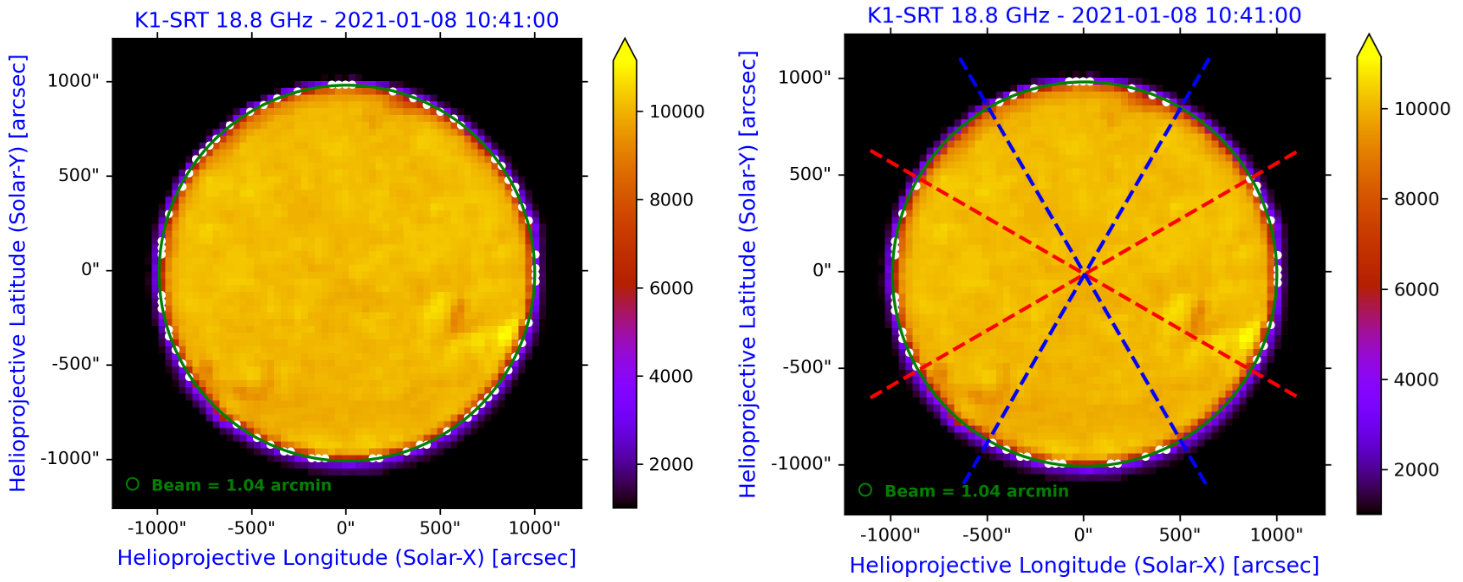
Study of solar brightness profiles in the 18-26 GHz frequency range with INAF radio telescopes I. Solar radius
We determine the mean, equatorial, and polar radii of the Sun in the frequency range 18.1 – 26.1 GHz. We employed single-dish observations from the newly appointed Medicina Gavril Grueff Radio Telescope and the Sardinia Radio Telescope (SRT) in five years, from 2018 to mid-2023, in the framework of the SunDish project for solar monitoring. Two methods for calculating the radius at radio frequencies were employed and compared: the half-power, and the inflection point. To assess the quality of our radius determinations, we also analysed the possible degrading effects of the antenna beam pattern on our solar maps using two 2D models (ECB and 2GECB). We carried out a correlation analysis with the evolution of the solar cycle by calculating Pearson’s correlation coefficient ρ in the 13-month running means. We obtained several values for the solar radius, ranging between 959 and 994 arcsec, and ρ, with typical errors of a few arcseconds. These values constrain the correlation between the solar radius and solar activity, and they allow us to estimate the level of solar prolatness in the centimeter frequency range. Our measurements are consistent with the values reported in the literature, and they provide refined estimates in the centimeter range. The results suggest a weak prolateness of the solar limb (equatorial radius > polar radius), although the equatorial and polar radii are statistically compatible within 3σ errors.
Published in Published in Astronomy & Astrophysics, Volume 684, id.A122, 18 pp