
A two-sided but significantly beamed jet in the supercritical accretion quasar IRAS F11119+3257
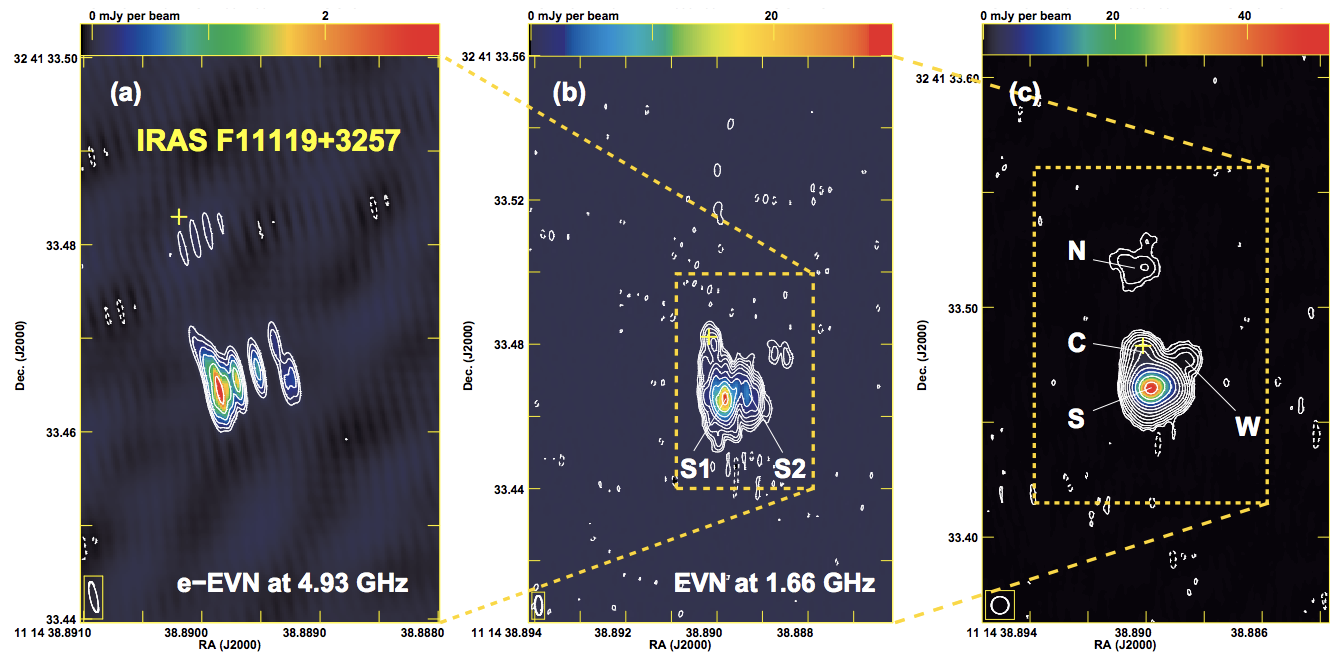
Highly accreting quasars are quite luminous in the X-ray and optical regimes. While, they tend to become radio quiet and have optically thin radio spectra. Among the known quasars, IRAS F11119+3257 is a supercritical accretion source because it has a bolometric luminosity above the Eddington limit and extremely powerful X-ray outflows. To probe its radio structure, we investigated its radio spectrum between 0.15 and 96.15 GHz and performed very-long-baseline interferometric (VLBI) observations with the European VLBI Network (EVN) at 1.66 and 4.93 GHz. The deep EVN image at 1.66 GHz shows a two-sided jet with a projected separation about two hundred parsec and a very high flux density ratio of about 290. Together with the best-fit value of the integrated spectral index of -1.31±0.02 in the optically thin part, we infer that the approaching jet has an intrinsic speed at least 0.57 times of the light speed. This is a new record among the known all kinds of super-Eddington accreting sources and unlikely accelerated by the radiation pressure. We propose a scenario in which IRAS F11119+3257 is an unusual compact symmetric object with a small jet viewing angle and a radio spectrum peaking at 0.53±0.06 GHz mainly due to the synchrotron self-absorption.
Published in Monthly Notices of the Royal Astronomical Society, Volume 494, Issue 2, pp.1744-1750