
VLBI observations of the H2O gigamaser in TXS2226-184
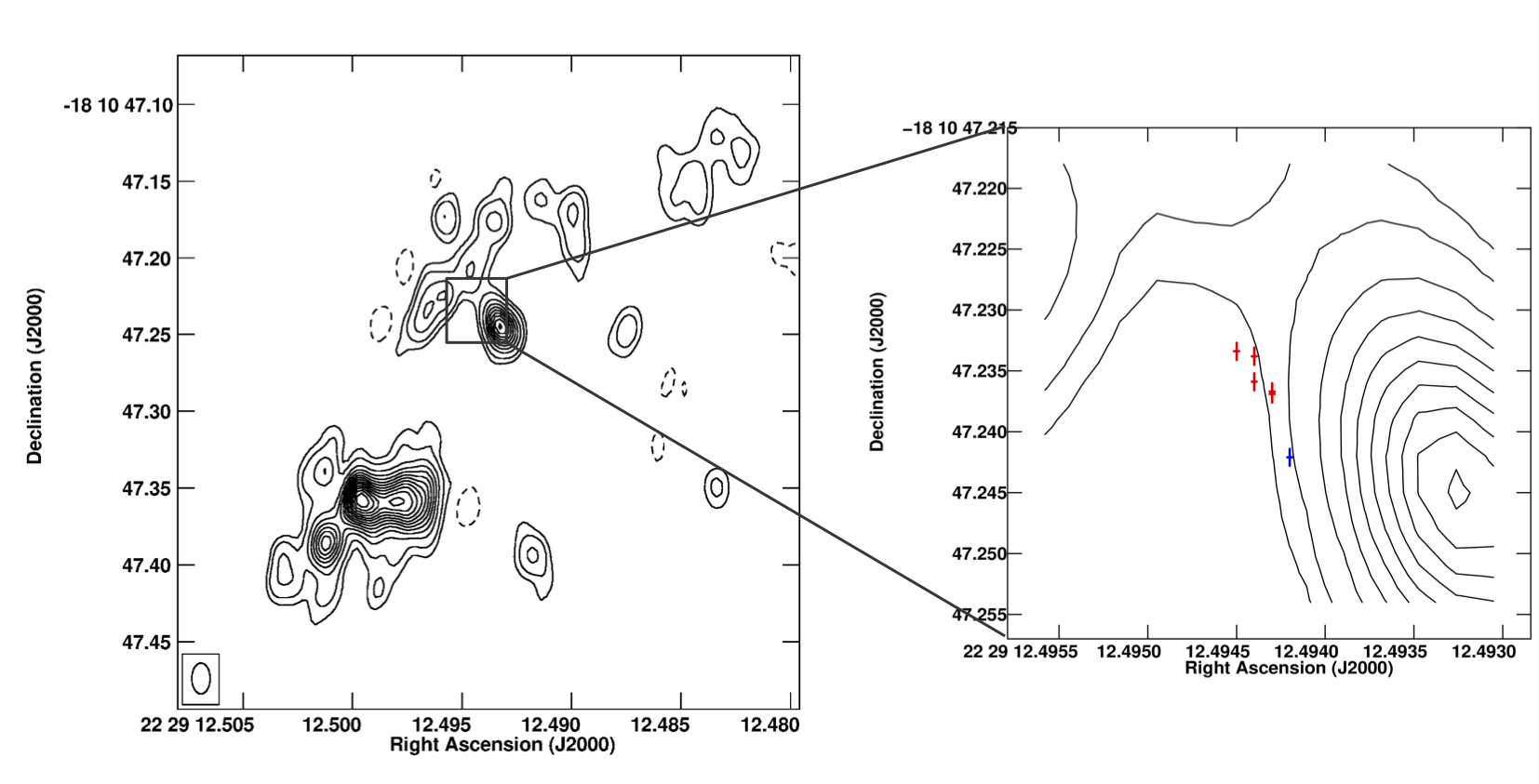
Outside the Milky Way, the most luminous H2O masers at 22 GHz, called 'megamasers' because of their extreme luminosity with respect to the Galactic and extragalactic H2O masers associated with star formation, are mainly detected in active galactic nuclei. In the case of the H2O maser detected in the nuclear region of the galaxy TXS2226-184 for the first time the term 'gigamaser' was used. However, the origin of this very luminous H2O maser emission has never been investigated into details. We study the nature of the H2O gigamaser in TXS2226-184 by measuring for the first time its absolute position at mas resolution, by comparing the morphology and characteristics of the maser emission at the VLBI scales after about 20 years, and by trying to detect its polarized emission. We observed the maser emission towards TXS2226-184 three times, the first time with the VLBA then with the EVN. In this last epoch the Sardinia Radio Telescope was part of the observing array, its participation allowed to decrease the thermal noise and consequently to increase the signal to noise ratio of the observations. All of the water maser features but one are red-shifted with respect to the systemic velocity of TXS2226-184, and for the first time we were able to measure their absolute position with errors below 1 mas. No linear and circular polarization was detected. We were also able to associate the H2O maser features in TXS2226-184 with the most luminous radio continuum clump reported in the literature.
Published in Astronomy & Astrophysics, Volume 637, id.A57, 12 pp.