
Sardinia Radio Telescope observations of Local Group dwarf galaxies - I. The cases of NGC 6822, IC 1613, and WLM
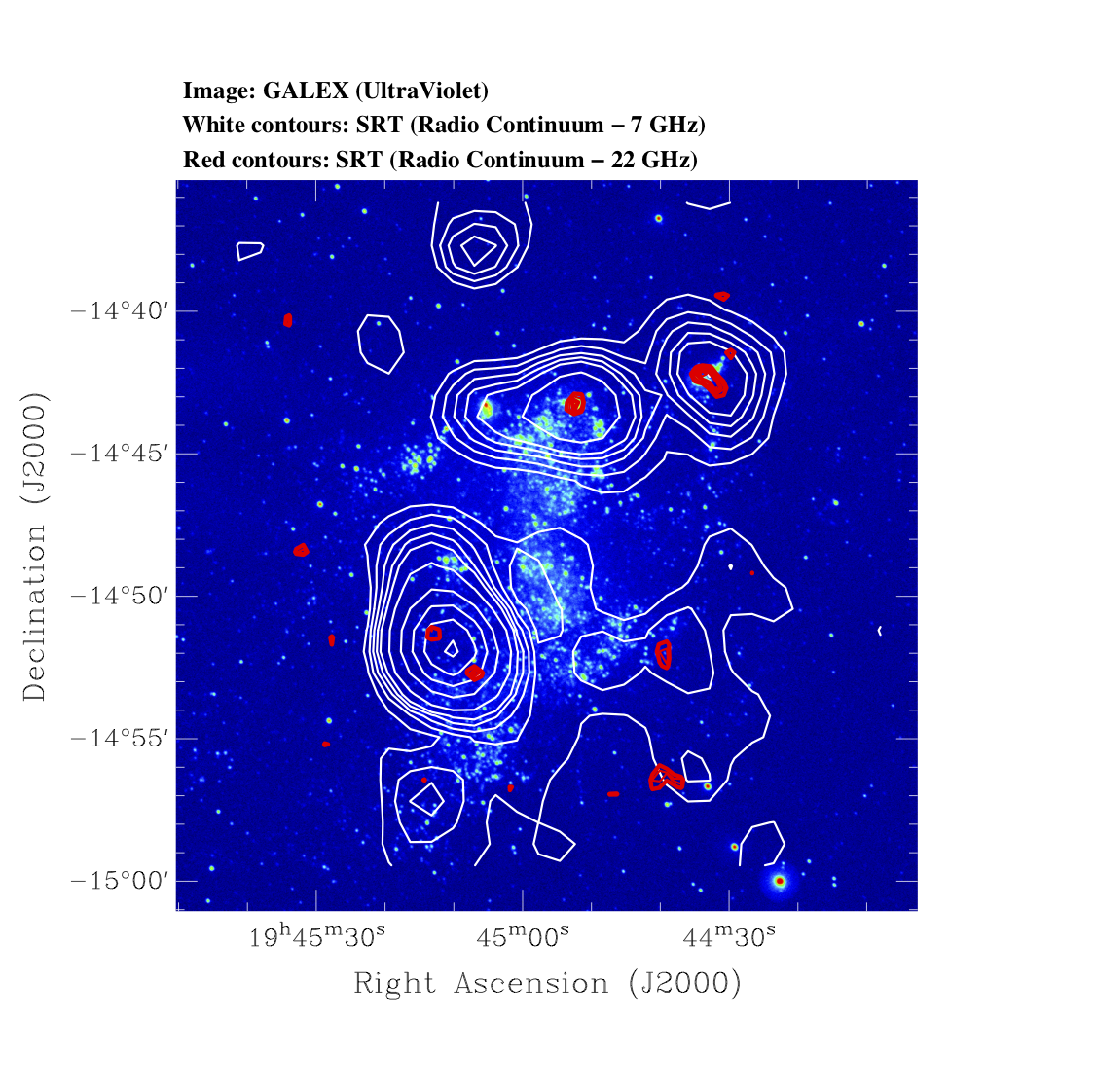
Almost all dwarf galaxies in the Local Group that are not satellites of the Milky Way or M31, belong to either one of two highly-symmetric planes. It is still a matter of debate, whether these planar structures are dynamically stable or whether they only represent a transient alignment. Proper motions, if they could be measured, could help to discriminate between these scenarios. Such motions could be determined with multi-epoch Very Long Baseline Interferometry (VLBI) of sources that show emission from water and methanol at frequencies of 22 and 6.7 GHz, respectively. We present a search for such masers performed with the SRT in three Local Group galaxies, NGC6822, IC1613 and WLM, members of the two above mentioned planes. Radio continuum maps of these galaxies have been obtained and used to identify star forming regions and to derive global galactic star formation rates. No methanol or water maser emission has been confidently detected, down to line luminosity limits of ~0.004 and 0.01 solar luminosities, respectively. This finding is consistent with the small sizes, low SFRs and metallicities of these galaxies.
Published in Monthly Notices of the Royal Astronomical Society, Volume 492, Issue 1, p.45-57