
Water masers in Compton-thick AGN. II. The high detection rate and EVN observations of IRAS 15480-0344
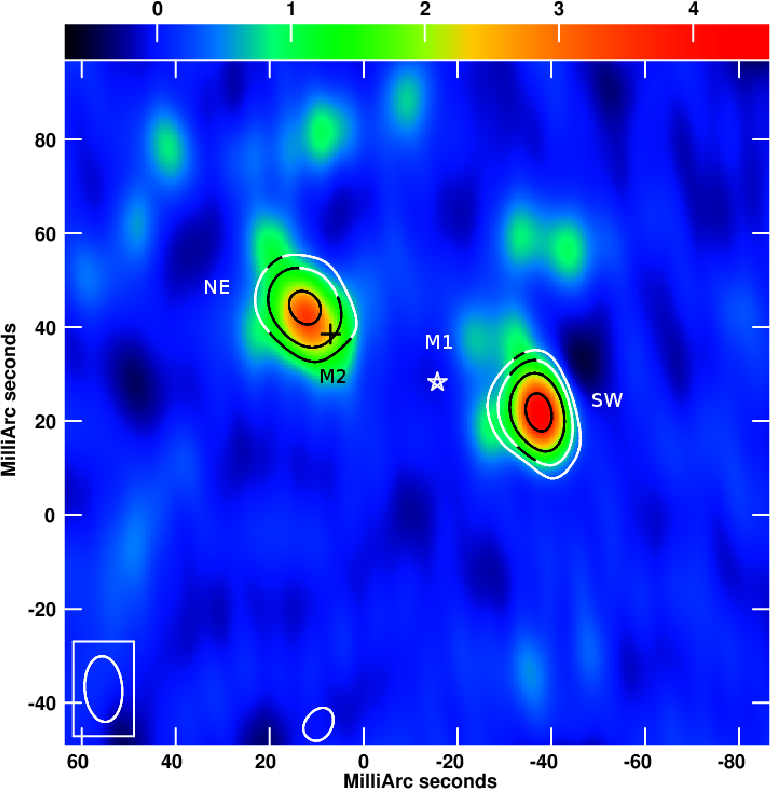
ca The radio emission from luminous H2O masers, the so-called “megamasers”, constitutes the only way to directly map the molecular gas at sub-parsec distance from supermassive black holes. Studies of megamaser sources not only allow us to constrain accretion disk geometry but also to improve our understanding of the jet (or outflows) interaction with the ISM of the host galaxies. Employing a sensitive array of EVN antennas, which included the SRT, we performed deep images of the nuclear radio continuum emission from the mid-IR-bright Seyfert 2 galaxy IRAS 15480−0344 which hosts a luminous H2O maser. We resolved the radio continuum emission from the innermost regions of IRAS 15480-0344 into two bright components (labeled SW and NE). The properties of these sources (spectral indices, brightness temperatures, dimensions, and radio power) indicate that their radio emission is synchrotron radiation, most likely produced by two weak knots, part of a compact radio jet. Both components show evidences for strong interaction with a dense interstellar medium. VLBI observations allowed us to locate the masers positions w.r.t. the main nuclear components, determining the nature of the water maser. Indeed, the narrow maser line, M1, might trace the position of the core (not visible in the radio continuum images) and be associated with the accretion disk or a nuclear outflow. The broad maser feature, M2, instead, coincides with source NE, suggesting that the maser emission might be produced by the interaction of the jet with the interstellar medium, as it was proposed for the masers in NGC 1068 and Mrk 348, adding a new source to the few confirmed jet-masers reported so far.
Published in Astronomy & Astrophysics, Volume 629, id.A25, 11 pp.