Strong Evidence of Anomalous Microwave Emission from the Flux Density Spectrum of M31
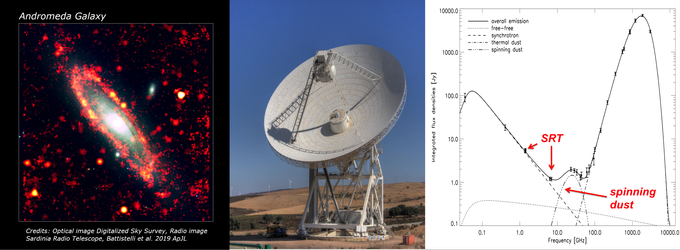
The Andromeda galaxy is the largest of the galaxies of the Local Group hosting also our Milky Way. It is a very well studied galaxy at all wavelengths with the exception of the microwave band. Thanks to the observations undertaken with the 64-m Sardinia Radio Telescope, we completely mapped the Andromeda galaxy in the microwave band at wavelength of 4,5cm (frequency 6.7GHz), with the aim to study its astrophysical emission and the reasons for such emission. Thanks to the state of the art technology implemented in the SRT, as well as to the excellent sensitivity and stability of the observations, it has been observed that, beyond the classical emission mechanisms originated by the interaction of the interstellar medium with the galaxy magnetic field, Andromeda shows the Anomalous emission in excess with respect to what expected which requires a new emission mechanism. The most accepted models foresee that this emission is due to rapidly rotating very small dust grains of the interstellar medium, emitting through electric dipole emission: Spinning Dust.
Published in The Astrophysical Journal Letters, Volume 877, Issue 2, article id. L31, 7 pp. (2019).