
Resolving the Decades-long Transient FIRST J141918.9+394036: An Orphan Long Gamma-Ray Burst or a Young Magnetar Nebula?
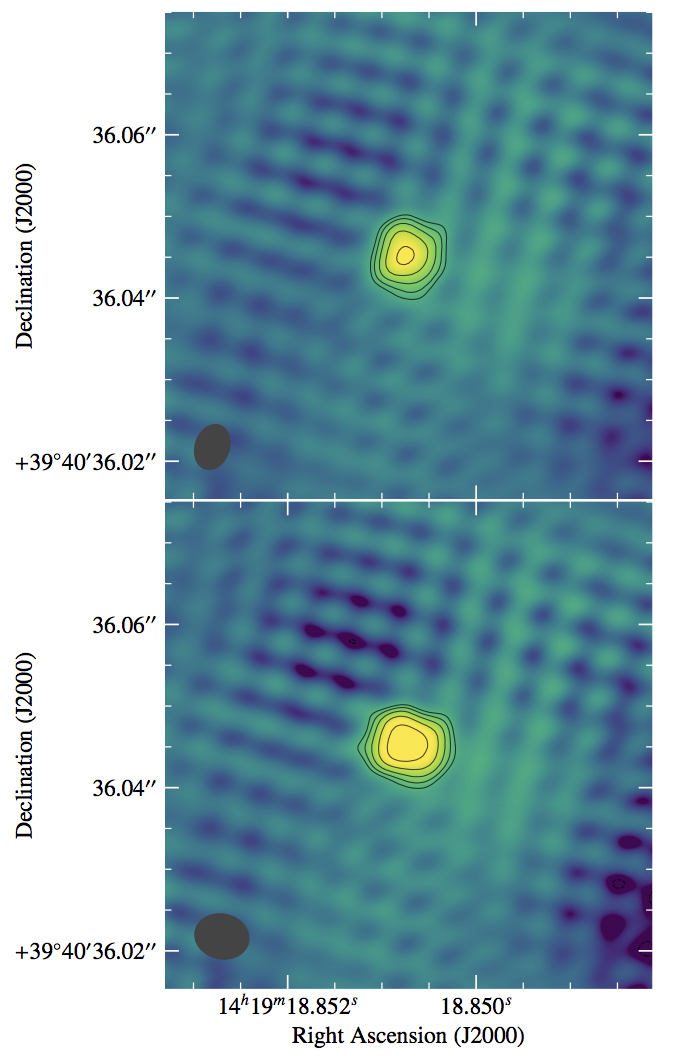
FIRST J1419+3940 was identified as a radio source sharing similar properties and host galaxy type to the compact, persistent radio source associated with the first known repeating fast radio burst, FRB 121102. FIRST J1419+3940 is a transient source decaying in brightness over the last few decades. One possible interpretation is that it is a nearby analogue to FRB 121102 and that the radio emission represents a young magnetar nebula. Another interpretation is that FIRST J1419+3940 is the afterglow of an ‘orphan’ long gamma-ray burst (GRB). The environment is similar to where most such events are produced. To distinguish between these hypotheses, we conducted radio observations using the European VLBI Network at 1.6 GHz to spatially resolve the emission and to search for millisecond-duration radio bursts. We detect FIRST J1419+3940 as a compact radio source with a flux density of 620 ± 20 µJy and a source size of 3.9 ± 0.7 mas (i.e. 1.6 ± 0.3 pc given the angular diameter distance of 83 Mpc). These results confirm that the radio emission is non-thermal and imply an average expansion velocity of (0.10 ± 0.02)c. The source properties and lack of short-duration bursts are consistent with a GRB jet expansion, whereas they disfavor a magnetar birth nebula.
Published in The Astrophysical Journal Letters, Volume 876, Issue 1, article id. L14, 7 pp. (2019).