
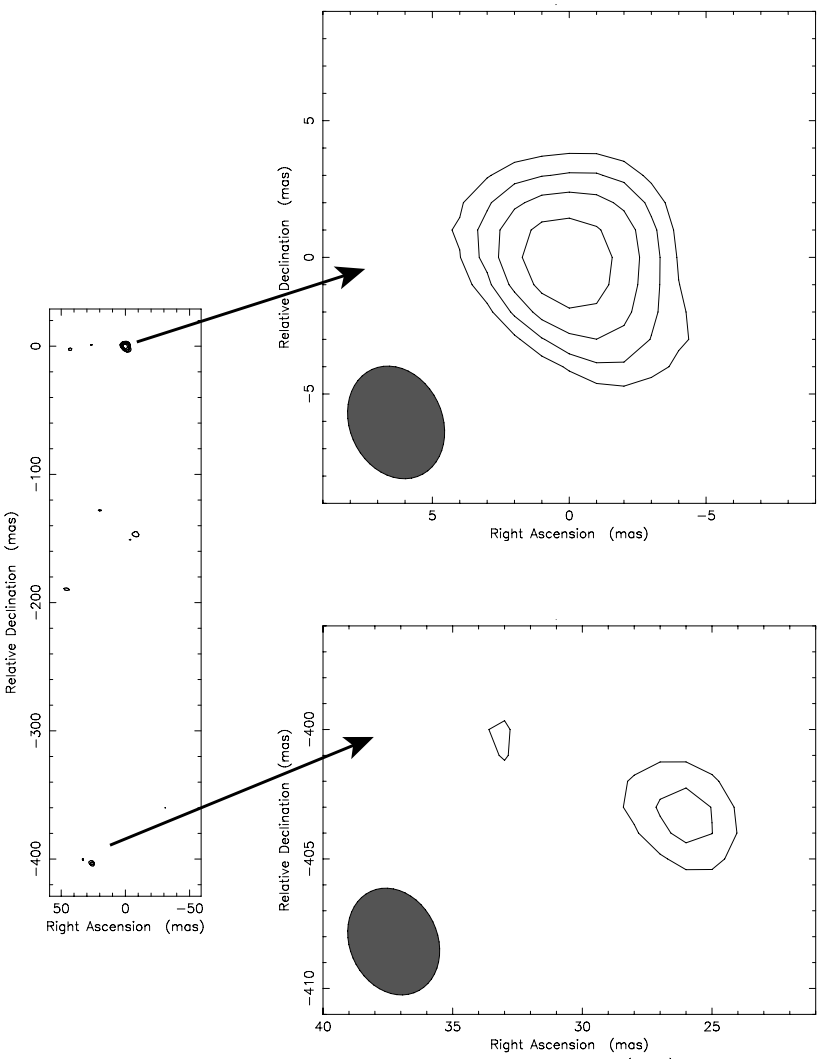
VLBI Non-detection of a Candidate Dual AGN in a Galaxy Merger
Numerical hydrodynamical simulations show that nuclear activity is experienced in multiple episodes during major galaxy mergers. Simultaneous activity in both nuclei becomes most likely at separations < 10 kpc. These systems where the central supermassive black holes (SMBHs) are still gravitationally unbound are called dual active galactic nuclei (AGNs). Characterizing a large sample of dual AGNs would help constraining the merger rate of galaxies and SMBHs, understanding the role of galaxy mergers in triggering AGN activity, and making predictions for SMBH coalescence producing gravitational waves. However, securely identified dual AGNs are rare. Confirmation of each case would ideally require AGN indicators at multiple wavebands. Although radio emission is associated with a minority of AGNs, the very long baseline interferometry (VLBI) technique plays a unique role in confirming emission from dual AGNs, owing to its high angular resolution.
Published in Research Notes of the American Astronomical Society, Volume 3, Issue 1, article id. 1 (2019).