
Mapping the neutral atomic hydrogen gas outflow in the restarted radio galaxy 3C 236
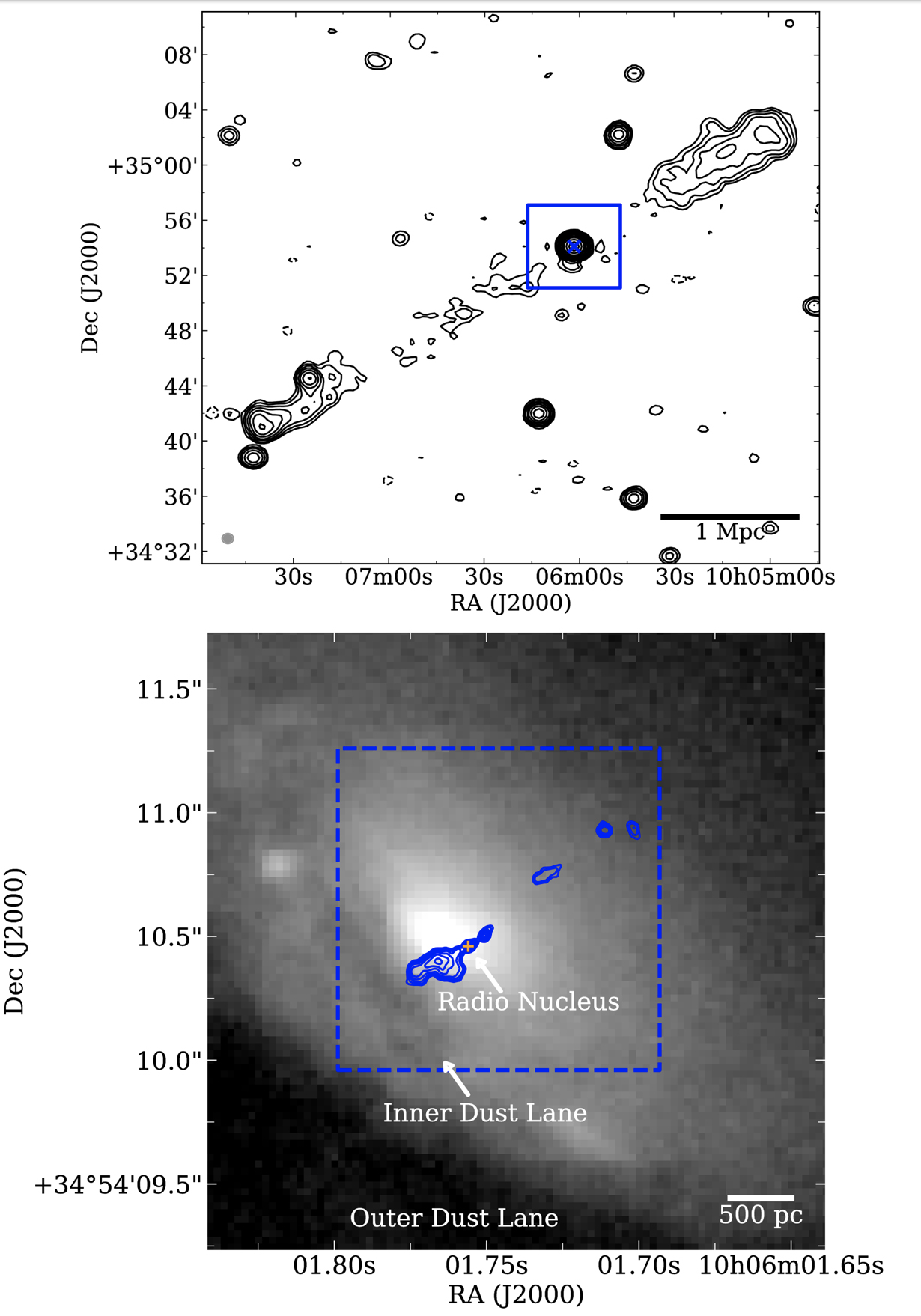
The energetic feedback that is generated by radio jets in active galactic nuclei (AGNs) has been suggested to be able to produce fast outflows of atomic hydrogen (H I) gas, which can be studied in absorption at high spatial resolution. We have used the Very Large Array (VLA) and a global very long baseline interferometry (VLBI) array to locate and study in detail the H I outflow discovered with the Westerbork Synthesis Radio Telescope (WSRT) in the restarted radio galaxy 3C 236. Based on the VLA data, we confirm a blueshifted wing of the H I with a width of 1000 km/s. This H I outflow is partially recovered by the VLBI observation. In particular, we detect four clouds with masses of 0.28 - 1.5 × 10^4M⊙ with VLBI that do not follow the regular rotation of most of the H I. Three of these clouds are located, in projection, against the nuclear region on scales of ≲40 pc, while the fourth is cospatial to the southeast lobe at a projected distance of 270 pc. Their velocities are between 150 and 640 km/s blueshifted with respect to the velocity of the disk-related H I. These findings suggest that the outflow is at least partly formed by clouds, as predicted by some numerical simulations, and that it originates already in the inner (few tens of pc) region of the radio galaxy. Our results indicate that the entire outflow might consist of many clouds, possibly with comparable properties as those clearly detected, but distributed at larger radii from the nucleus where the lower brightness of the lobe does not allow us to detect them.
Published in Astronomy & Astrophysics, Volume 617, id.A38, 12 pp.