
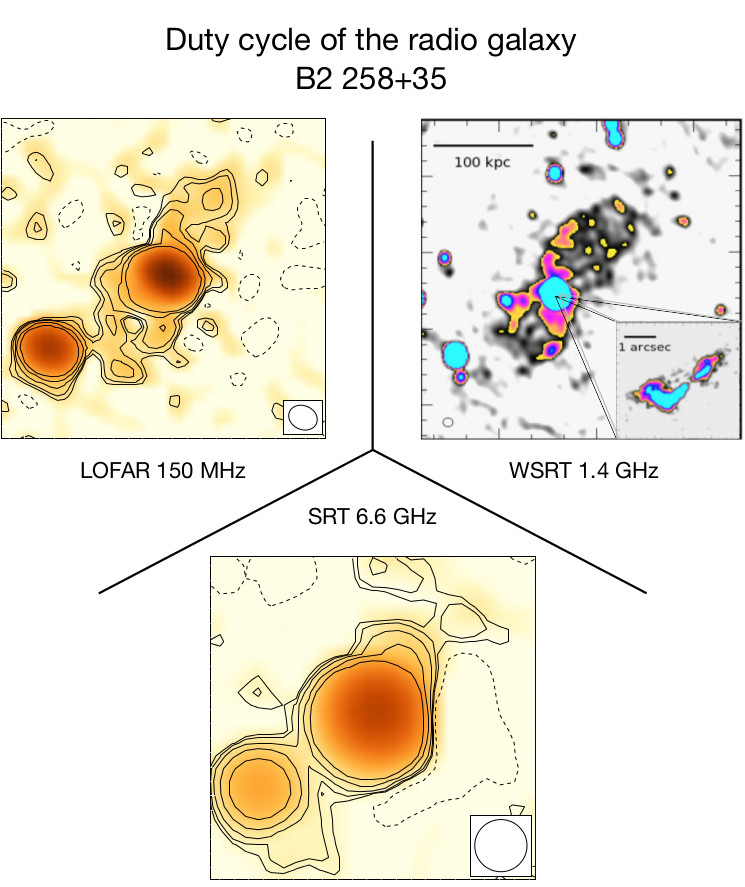
Duty cycle of the radio galaxy B2 0258+35
We have investigated the duty cycle of the radio source B2 0258+35, which was previously suggested to be a restarted radio galaxy based on its morphology. The radio galaxy consists of a pair of kpc-scale jets embedded in two large-scale lobes (240 kpc) with relaxed shape and very low surface brightness that resemble remnants of a past AGN activity. Thanks to a combination of new SRT observations at 6600 MHz with new LOFAR observations at 145 MHz and archive WSRT data at 1400 MHz, we have investigated the spectral properties of the outer lobes to derive their age. Interestingly, the spectrum of both the Northern and Southern lobes is not ultra-steep or significantly curved over the entire available frequency range as expected for an old ageing plasma. We conclude that either the large-scale lobes are still fuelled by the nuclear engine or the jets have switched off no more than a few tens of Myr ago, allowing us to observe both the inner and outer structure simultaneously. Our study shows the importance of combining morphological and spectral properties to reliably classify the evolutionary stage of low surface brightness, diffuse emission that low frequency observations are revealing around a growing number of radio sources.
Published in Astronomy & Astrophysics, Volume 618, id.A45, 12 pp.