
The Survey for Pulsars and Extragalactic Radio Bursts - II. New FRB discoveries and their follow-up
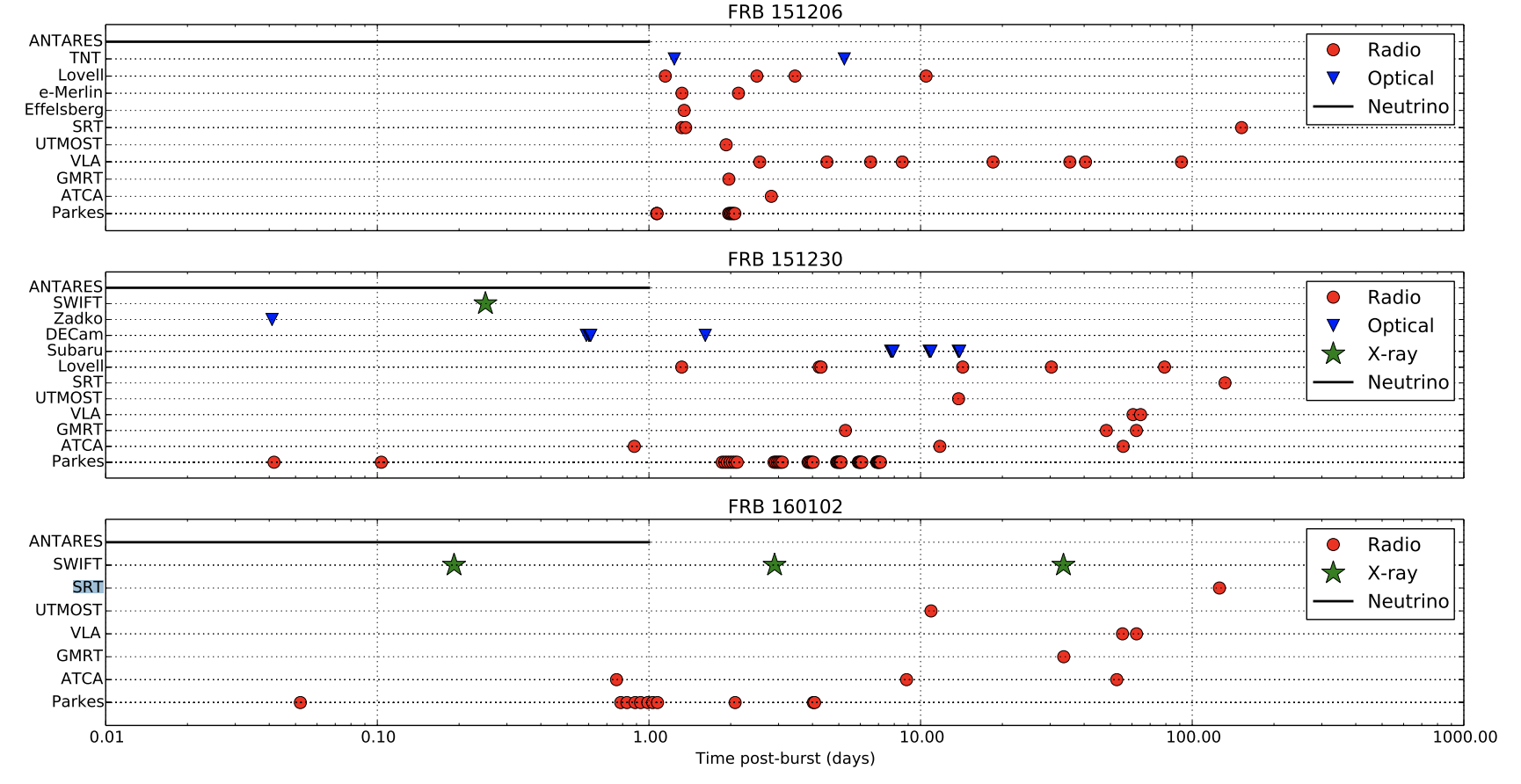
We report the discovery of four Fast Radio Bursts (FRBs) in the ongoing SUrvey for Pulsars and Extragalactic Radio Bursts at the Parkes Radio Telescope: FRBs 150610, 151206, 151230 and 160102. Our real-time discoveries have enabled us to conduct extensive, rapid multimessenger follow-up at 12 major facilities sensitive to radio, optical, X-ray, gamma-ray photons and neutrinos on time-scales ranging from an hour to a few months post-burst. No counterparts to the FRBs were found and we provide upper limits on afterglow luminosities. None of the FRBs were seen to repeat. Formal fits to all FRBs show hints of scattering while their intrinsic widths are unresolved in time. FRB 151206 is at low Galactic latitude, FRB 151230 shows a sharp spectral cut-off, and FRB 160102 has the highest dispersion measure (DM = 2596.1 ± 0.3 pc cm-3) detected to date. Three of the FRBs have high dispersion measures (DM > 1500 pc cm-3), favouring a scenario where the DM is dominated by contributions from the intergalactic medium.
Published in Monthly Notices of the Royal Astronomical Society, Volume 475, Issue 2, p.1427-1446