
The 999th Swift gamma-ray burst: Some like it thermal. A multiwavelength study of GRB 151027A (3)
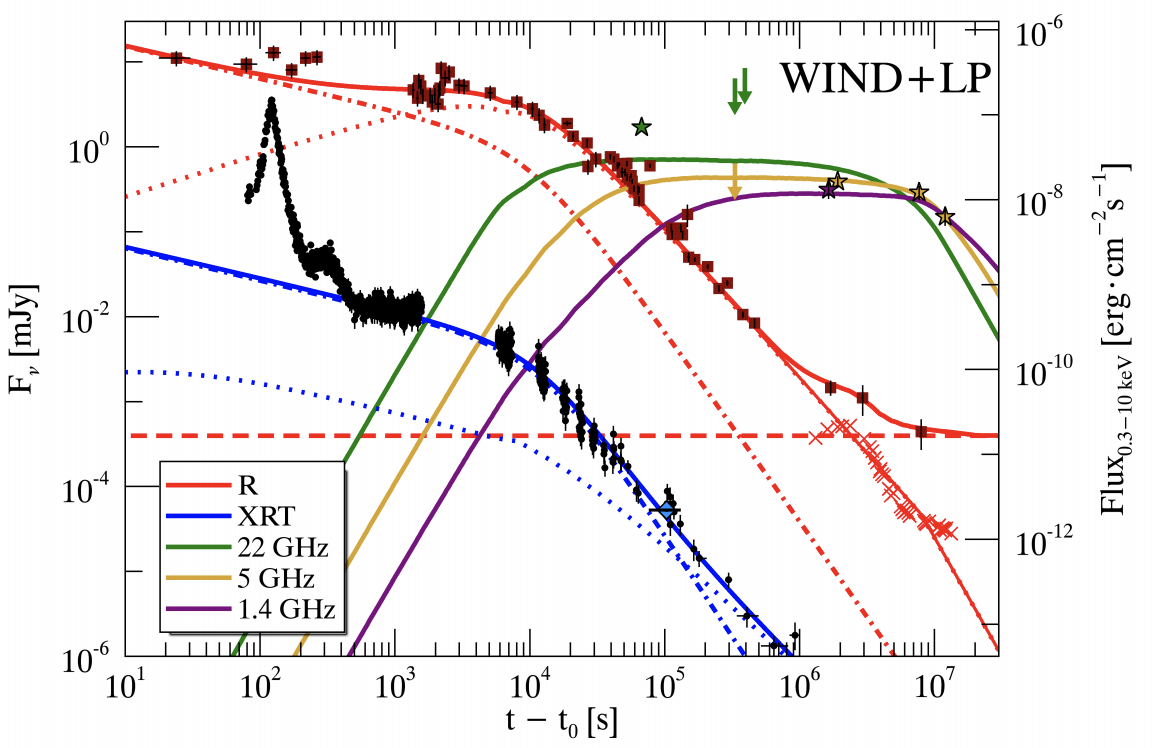
We present a multiwavelength study of GRB 151027A. This is the 999th gamma-ray burst detected by the Swift satellite and it has a densely sampled emission in the X-ray and optical band and has been observed and detected in the radio up to 140 days after the prompt. The multiwavelength light curve from 500 s to 140 days can be modelled through a standard forward shock afterglow, but it requires an additional emission component to reproduce the early X-ray and optical emission. Radio observations, performed with the Sardinia Radio Telescope (SRT) and Medicina in single-dish mode and with the European Very Long Baseline Interferometer (VLBI) Network and the Very Long Baseline Array (VLBA), between day 4 and 140 suggest that the burst exploded in an environment characterized by a density profile scaling with the distance from the source (wind profile).
Published in Astronomy & Astrophysics, Volume 598, id.A23, 17 pp.