
Single-dish and VLBI observations of Cygnus X-3 during the 2016 giant flare episode
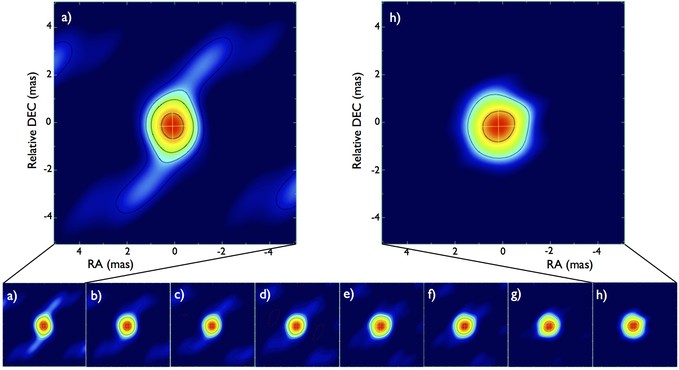
In September 2016, the microquasar Cygnus X-3 underwent a giant radio flare, which was monitored for 6 days with the Medicina Radio Astronomical Station and the Sardinia Radio Telescope. Long observations were performed in order to follow the evolution of the flare on a hourly scale, covering six frequency ranges from 1.5 GHz to 25.6 GHz. Rapid flux variations were observed at high radio frequencies at the peak of the flare, together with rapid evolution of the spectral index. This is the first time that such fast variations are observed. Based on the Italian network (Noto, Medicina and SRT) and extended to the European antennas (Torun, Yebes, Onsala), VLBI observations were triggered at 22 GHz on five different occasions, four times prior to the giant flare, and once during its decay phase. Flux variations of 2-hour duration were recorded.
Published in Monthly Notices of the Royal Astronomical Society, Volume 471, Issue 3, p.2703-2714