
Monitoring of the polarized H2O maser emission around the massive protostars W75N(B)-VLA 1 and W75N(B)-VLA 2
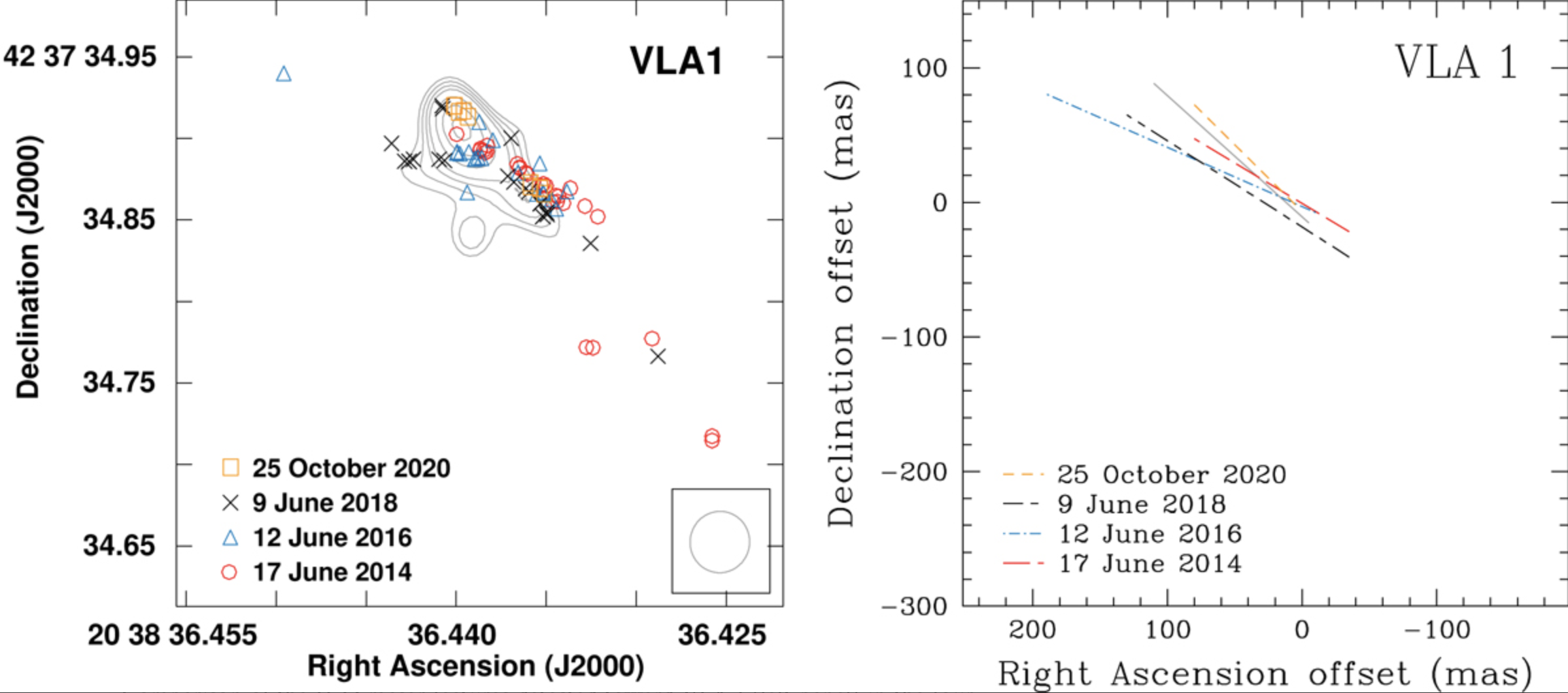
Several radio sources have been detected in the high-mass star-forming region W75N(B), with the massive young stellar objects VLA 1 and VLA 2 shown to be of particular interest among them. These objects are thought to be at different evolutionary stages: VLA 1 is in the early stage of photoionization and driving a thermal radio jet, while VLA 2 is a thermal, collimated ionized wind surrounded by a dusty disk or envelope. In both sources, 22 GHz H2O masers have been detected in the past. Those around VLA 1 show a persistent linear distribution along the thermal radio jet, while those around VLA 2 have traced the evolution from a non-collimated to a collimated outflow over a period of ∼20 yr. The magnetic field inferred from the H2O masers has shown an orientation rotation following the direction of the major-axis of the shell around VLA 2, whereas it is immutable around VLA 1. By monitoring the polarized emission of the 22 GHz H2O masers around both VLA 1 and VLA 2 over a period of six years, we aim to determine whether the H2O maser distributions show any variation over time and whether the magnetic field behaves accordingly. The European VLBI Network was used in full polarization and phase-reference mode in order to determine the absolute positions of the 22 GHz H2O masers with a beam size of ∼1 mas and to determine the orientation and the strength of the magnetic field. We observed four epochs separated by two years from 2014 to 2020. We detected polarized emission from the H2O masers around both VLA 1 and VLA 2 in all the epochs.
Published in Astronomy & Astrophysics, Volume 673, id.A10, 32 pp.