Design, Fabrication, and Electromagnetic Characterization of a Feed Horn of the Linear-Polarized Multi-Beam Cryogenic S-Band Receiver for the Sardinia Radio Telescope
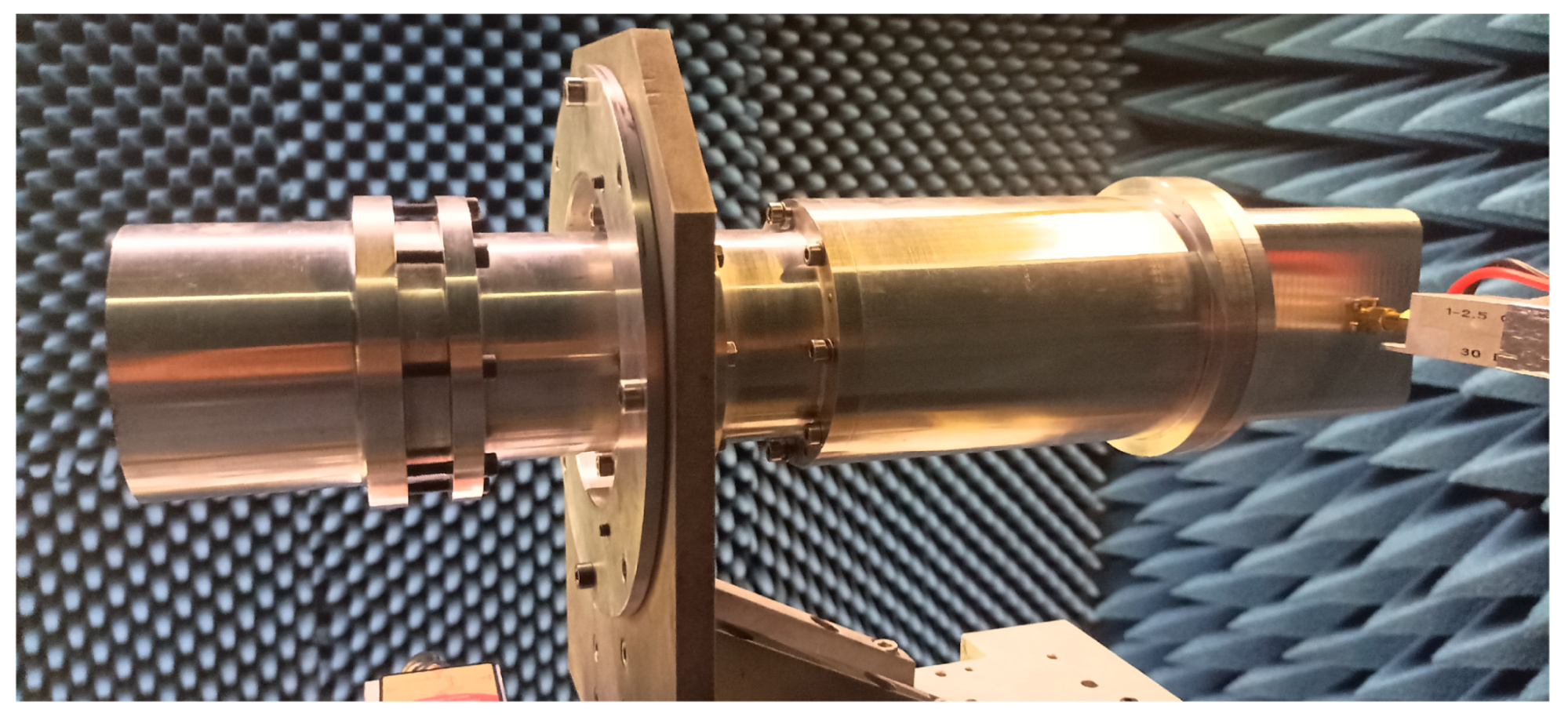
The S-band (i.e., 2–4 GHz) is essential in multiple fields of radio astronomy, ranging from pulsar and solar studies to investigations of the early universe. The Italian 64 m fully steerable Sardinia Radio Telescope (SRT) is a system designed to operate in a wide frequency band ranging from 300 MHz to 116 GHz. Recently, the Astronomical Observatory of Cagliari (OAC) has been developing a new cryogenic seven-beam S-band radio receiver. This paper describes the design, fabrication and electromagnetic characterization of the feed horn for this new receiver. It has been designed to observe the sky in the 3–4.5 GHz frequency range and it will be composed of seven feed horns arranged in a regular hexagonal layout with a central element. The feed horns are optimized for placement in the primary focus and consequently illuminate the 64 m primary mirror of the SRT. The electromagnetic characterization of the single feed horn is crucial to verify the receiver’s performance; for this reason, a single feed horn has been manufactured to compare the measured reflection coefficient and the radiated far-field diagram with the results of the electromagnetic simulations, performed using the CST® Suite Studio 2024 and Ansys HFSS® Electromagnetics Suite 2021 R1 (To make the S-parameters and the radiation diagram measurement procedure feasible, the single feed horn has been connected to two adapters: a circular-to-rectangular waveguide adapter and a coax-to-rectangular waveguide adapter. The results of the measurements performed in the anechoic chamber are in very good agreement with the simulated results. Additionally, the feed horn phase center position is evaluated, merging the measurements and simulations results for an optimal installation on the primary focus of the SRT.
Published in Electronics 2025, 14(11), 2301