
Correlation between active regions’ spectra at high radio frequencies and solar flare occurrences
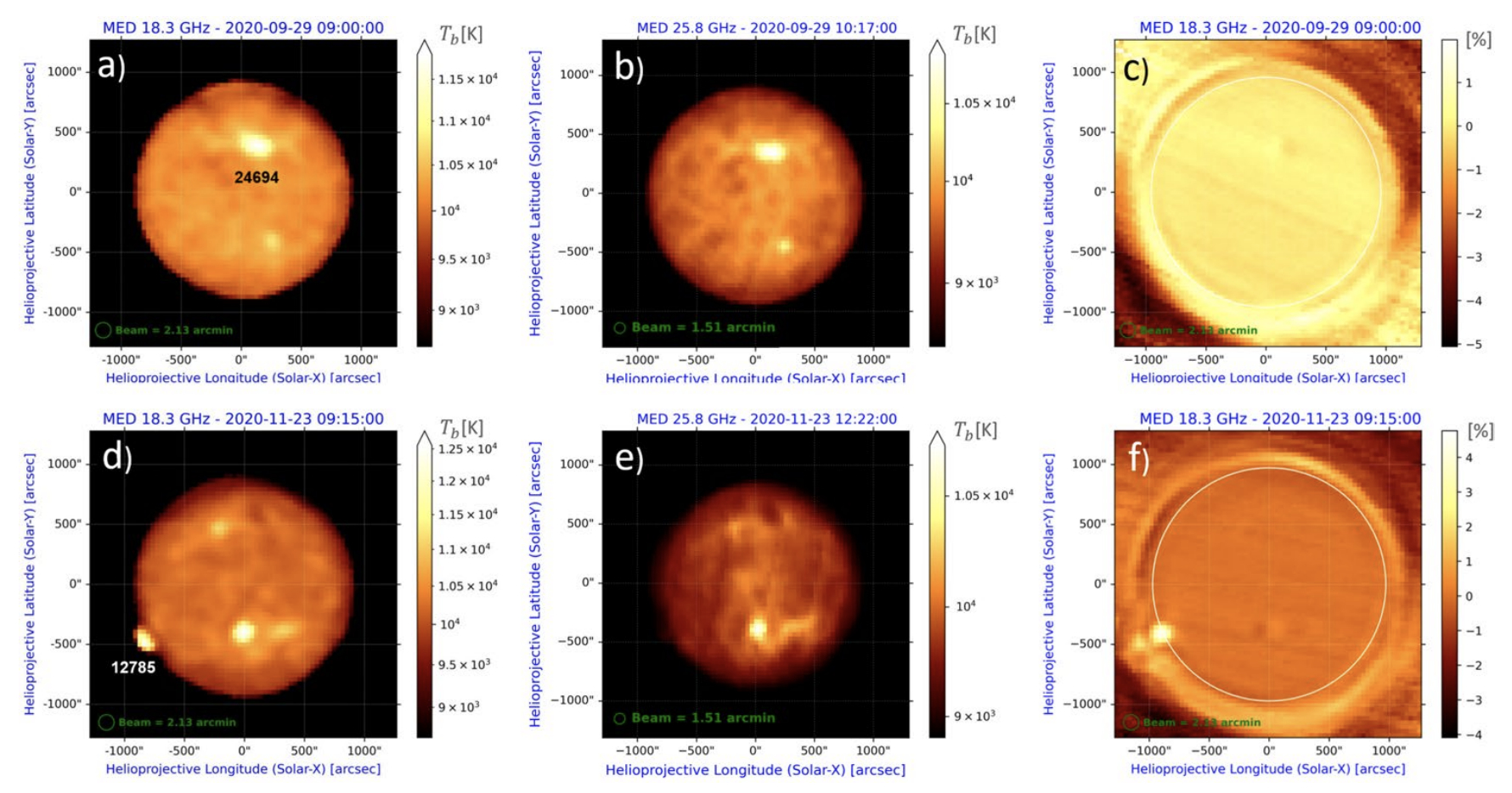
High radio frequencies observations with the Italian network of large single-dish radio telescopes resulted in ∼450 solar images between 2018 and 2023 in K-band frequency range (18–26 GHz). Solar radio mapping at these frequencies allows the probing of the Active Regions (ARs) chromospheric magnetic field close to the Transition Region, where strong flares and coronal mass ejection events occur. Enhanced magnetic fields up to 1500–2000 G determine anomalous spectra in the ARs brightness compared to pure free-free emission, due to the addition of a steeper gyro-resonance component also associated with circular polarisation up to ∼40%. When a significant AR spectral flattening is detected, the probability of a strong flare occurrence within ∼30 hours is high (∼89% in terms of statistical precision). Despite an approximate weekly cadence of our observations, only ∼12% of strong flares are missed/unpredicted within this time interval. Through a correlation analysis, we assess the trade-off on the sensitivity and the robustness of this physics-based flare forecast method.
Published in Scientific Reports, 15, Article number: 44237 (2025)