
The magnetic field of a magnetohydrodynamic disk wind: Water maser observations and simulations
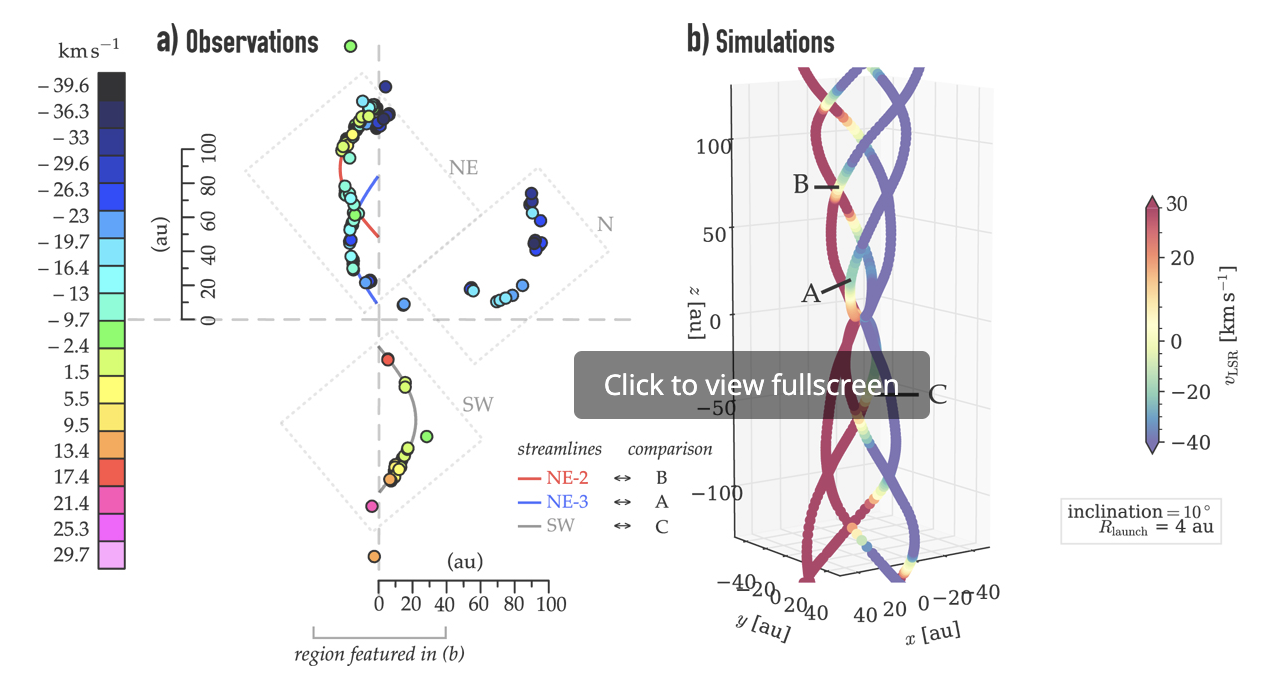
Although star-formation models predict that the magnetic field plays an important role in regulating disk-mediated accretion and launching and collimating protostellar jets, observations of the magnetic field close enough (within a few 100 au) to the forming stars are still sparse. Our goal is to measure and model the magnetic field distribution in the disk wind of the young stellar object (YSO) IRAS 21078+5211. We performed sensitive global very long baseline interferometry observations of the polarized emission of the 22 GHz water masers tracing individual streamlines of the magnetohydrodynamic (MHD) disk wind in IRAS 21078+5211. Our resistive-radiativegravito-MHD simulations of a jet around a forming massive star are able to closely reproduce the observed maser kinematics in the inner jet cavity. Results: We measure a weak level of 0.3-3.2% of linear and circular polarization in 24 and 8 water masers, respectively. The detected polarized masers sample the direction and the strength of the magnetic field along five distinct streamlines within the inner 100 au region of the disk wind. Along the four streamlines at smaller radii from the jet axis (≤25 au), the sky-projected direction of the magnetic field forms, in most cases, a small offset angle of ≤30º with the tangent to the streamline. Along the stream at larger radii (50-100 au), the magnetic field is sampled at only three separated positions, and it is found to be approximately perpendicular to the streamline tangent at heights of ≈10 and 40 au, and parallel to the tangent at ≈70 au. According to our simulations, the magnetic field lines should coincide with the flow streamlines in the inner jet cavity. The small tilt in the magnetic field direction observed along the inner streams can be well explained by Faraday rotation, assuming a realistic low level of ionization for the molecular shell of the jet of namely ~10−2.
Published in Astronomy & Astrophysics, Volume 680, id.A107, 14 pp.