Performance of the Sardinia Radio Telescope Using the Dual-Polarized Cryogenic C-Low Receiver in the 4.2–5.6 GHz Frequency Band
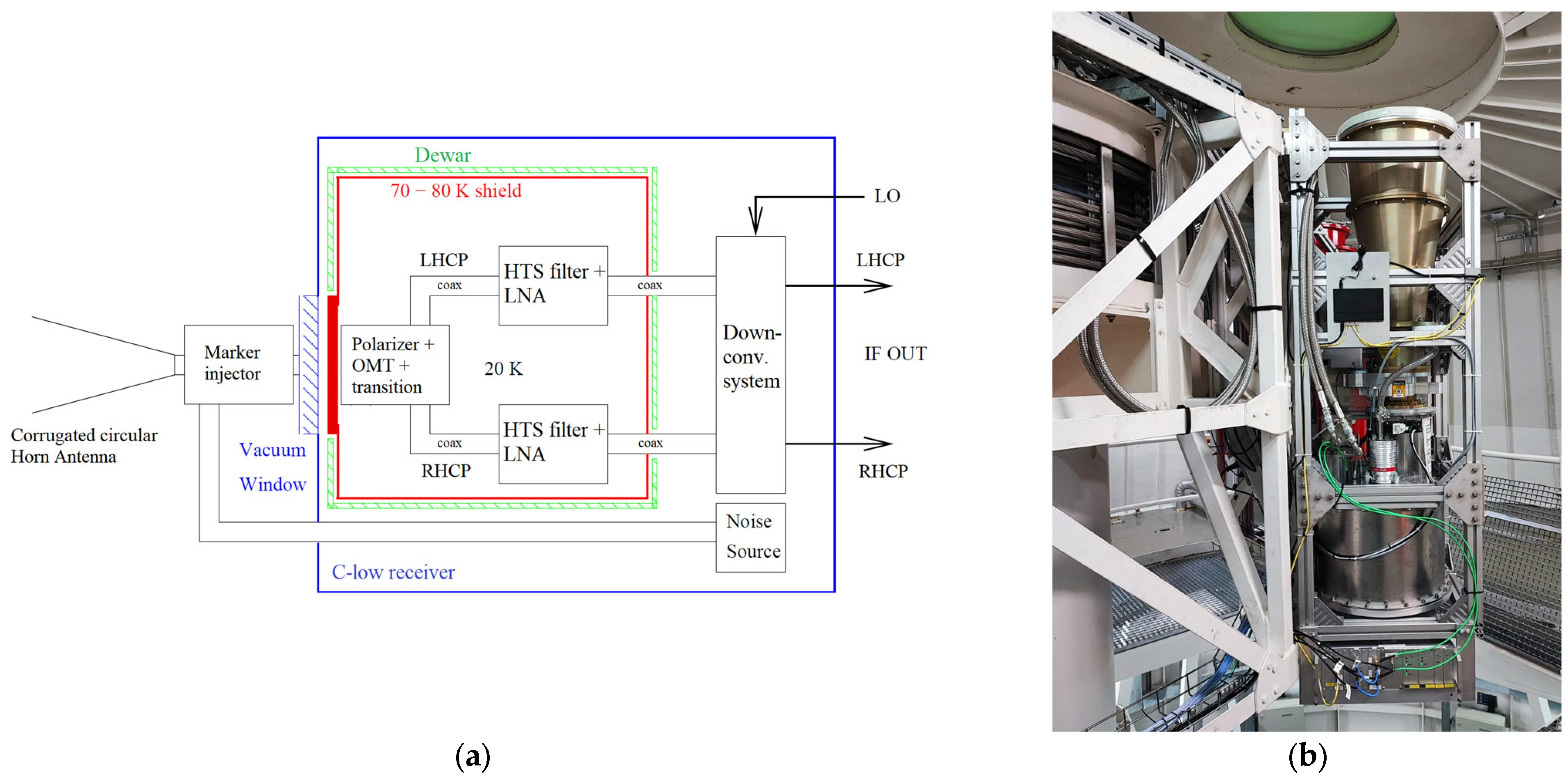
The Sardinia Radio Telescope (SRT) is an Italian antenna utilized for scientific research in the field of radio astronomy across a broad frequency range from 300 MHz to 116 GHz. Among the various cryogenic receivers installed on SRT, the dual-polarized C-Low receiver operates within the frequency range of 4.2–5.6 GHz, which is the lower portion of the well-known Cband, and is installed at the Gregorian focus of the telescope. This article presents a general description of the design of the receiver, highlighting its signal acquisition chain, which conditions weak signals from the sky for transmission to the digital back-end, responsible for data processing. An analysis of the radio-frequency interference environment affecting scientific observations is also presented, together with the adopted mitigation strategies. Finally, we report the results of the characterization tests performed with the C-Low receiver at SRT, focusing on the pointing accuracy model, gain-curve calibration, focuscurve calibration, and beam-shape analysis. The results of these characterization tests demonstrate the performance and accuracy of the C-Low receiver, providing a reference for future observations and instrumentation improvements.
Published in Published in Sensors 2026, 26(2), 698