
First demonstration of super-resolution with a singleaperture radio telescope
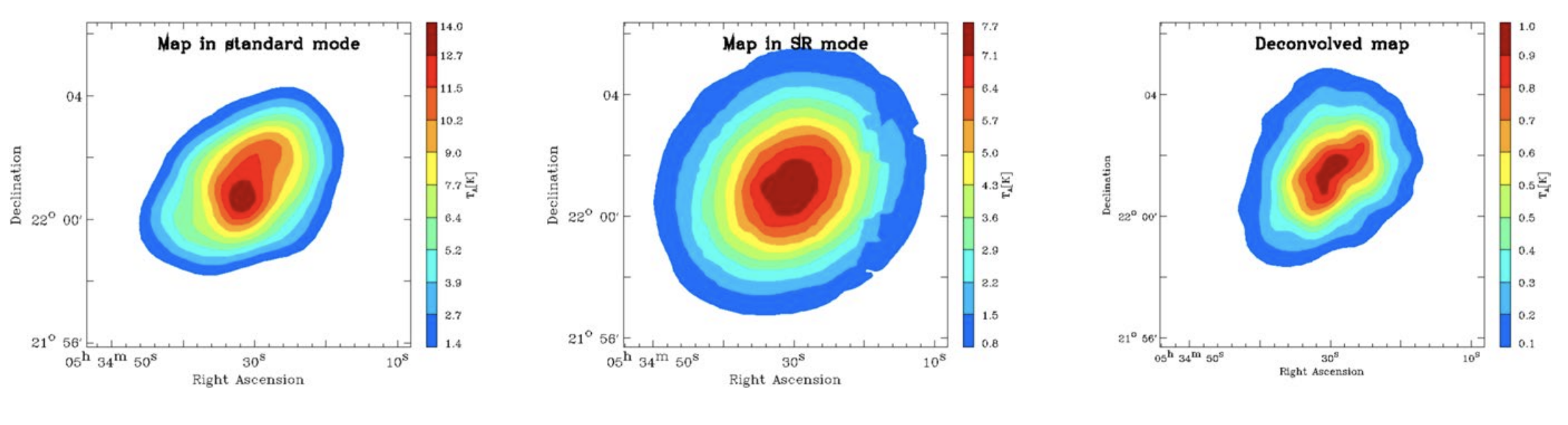
In this paper we report the first successful demonstration of angular super-resolution (SR) obtained with a single-aperture radio telescope observing in the microwave K-band. Despite the potential scientific applications, in the past few decades little efforts have been devoted to the development of SR imaging techniques for Astronomy, while most of the technological improvement has concentrated on focal plane instrumentation. In recent years, some complex and ambitious techniques have been proposed to achieve SR with astronomical telescopes, but none of these techniques has gone beyond the stage of basic principles or could be used as a real SR imaging method. Variable-transmittance pupils, and specifically Toraldo Pupils (TPs), represent one viable approach to achieving SR in radio astronomy. In this work we show that by exploiting the active surface of the Sardinia Radio Telescope (SRT) to emulate a TP at the entrance pupil of the telescope it is indeed possible to achieve a main beam narrower than that expected by diffraction. The reduction in the width of the main beam is achieved at the expense of a lower antenna efficiency and higher sidelobes. We have also used the resulting SR beam to map an astronomical source and we show that we are able to recover some of the compact structure not visible using the nominal diffraction-limited telescope beam. Once the method will be adequately tested and optimized, it will provide the telescope users with a new observing option, promising to expand the scientific capabilities of the SRT.
Published in Published in Experimental Astronomy 2026, 61, 5