
Multi-wavelength behaviour of the radio galaxy SBS 1343+537: γ-ray flaring activity discovered by Fermi-LAT and coordinated Swift and SRT observations
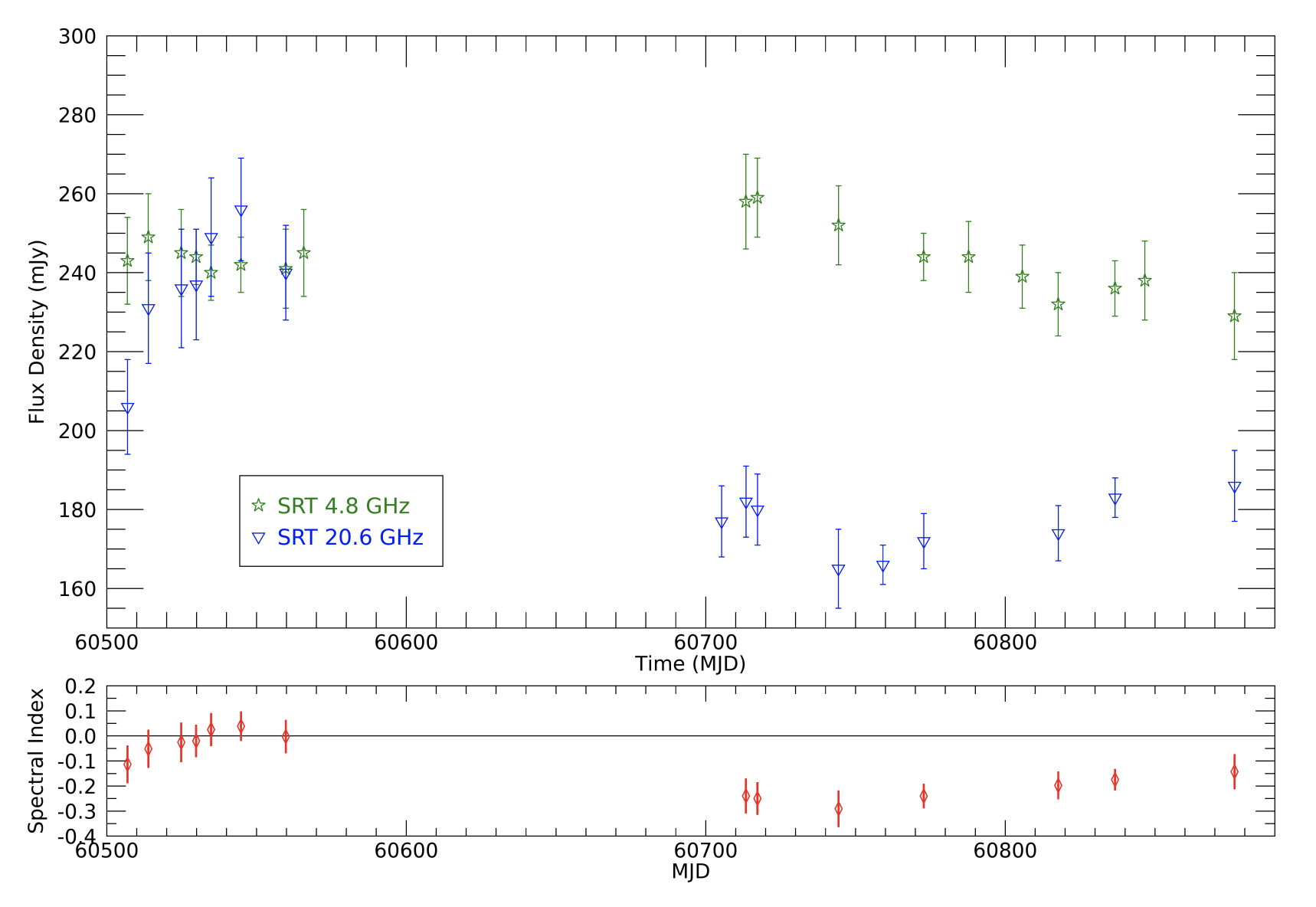
The SBS 1343+537 radio galaxy has a kiloparsec-scale radio jet, and complex kiloparsec-scale morphology. Although its classification is still uncertain, in literature it is indicated as a possible Fanaroff-Riley type I (FR-I) object with extended wings of emission, and core blazar-like properties. It was recently spatially associated with the GeV γ-ray source 4FGL J1346.5+5330, which detected by the Large Area Telescope (LAT), on board the Fermi Gamma-Ray Space Telescope. In June 2024, the Fermi Large Area Telescope (Fermi-LAT) observed enhanced γ-ray activity from SBS 1343+537. The event was followed up by the Neil Gehrels Swift Observatory satellite (Swift) and Sardinia Radio Telescope (SRT) observations. Here, we present multi-frequency data (radio, optical, Ultra Violet (UV), X-ray, and γ-ray) collected during this observing campaign. Our results confirm the detection of a short-lived γ-ray flare, consistent with a power-law spectrum. We report a stable X-ray flux, minor activity in the UV band, and a flux density increase in the radio 20 GHz band, which might indicate a mild spectral index inversion. The broadband spectral energy distribution (SED) modelling confirms a typical blazar-like emission in the core of this source, dominated by one-zone Synchrotron Self-Compton (SSC) and external Compton (EC) leptonic processes.
Accepted for publication in Astronomy & Astrophysics (2026)