
The MISTRAL Instrument and the Characterization of Its Detector Array
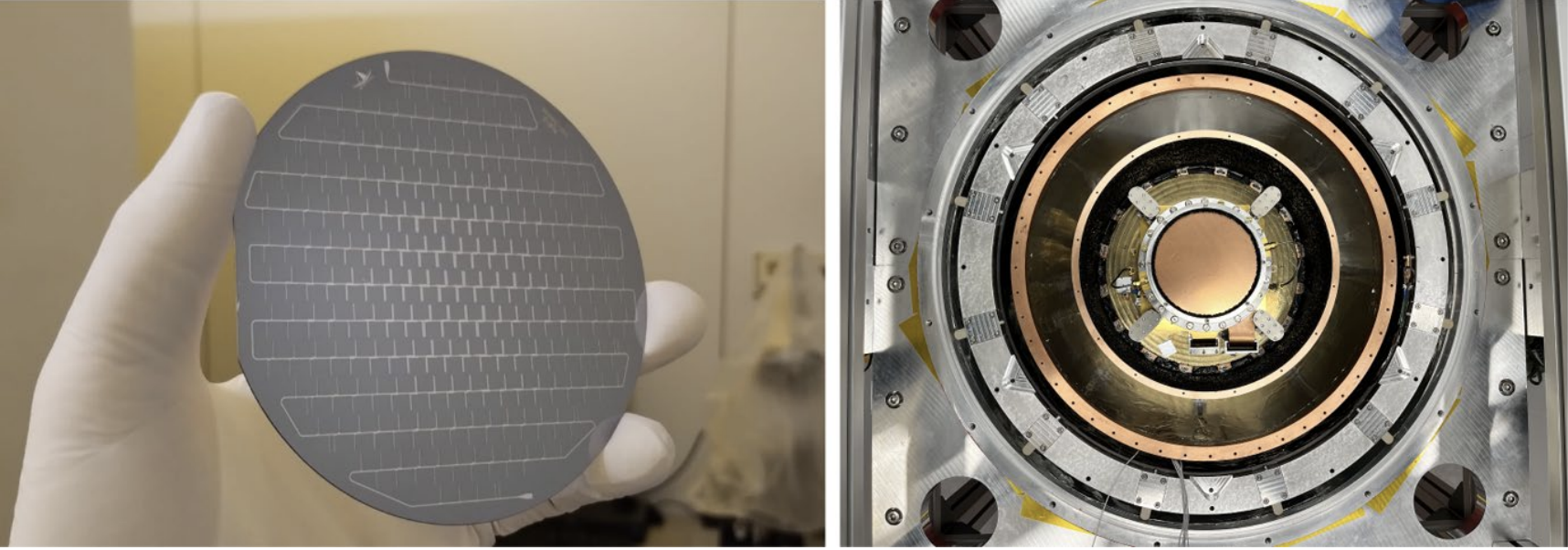
The MIllimeter Sardinia radio Telescope Receiver based on Array of Lumped elements KIDs, MISTRAL, is a cryogenic LEKID camera, operating in the W band (77−103 GHz) from the Gregorian focus of the 64-m aperture Sardinia Radio Telescope (SRT), in Italy. This instrument features a high angular resolution (∼ 12 arcsec) and a wide instantaneous field of view (∼ 4 arcmin), allowing continuum surveys of the mm-wave sky with many scientific targets, including observations of galaxy clusters via the Sunyaev–Zel’dovich effect. In May 2023, MISTRAL has been installed at SRT for the technical commissioning. In this contribution, we will describe the MISTRAL instrument focusing on the laboratory characterization of its focal plane: a ∼ 400-pixel LEKID array. We will show the optical performance of the detectors highlighting the procedure for the identification of the pixels on the focal plane, the measurements of the optical responsivity and NEP, and the estimation of the optical efficiency.
Published in Journal of Low Temperature Physics, Volume 217, Issue 3-4, pp. 436-445