
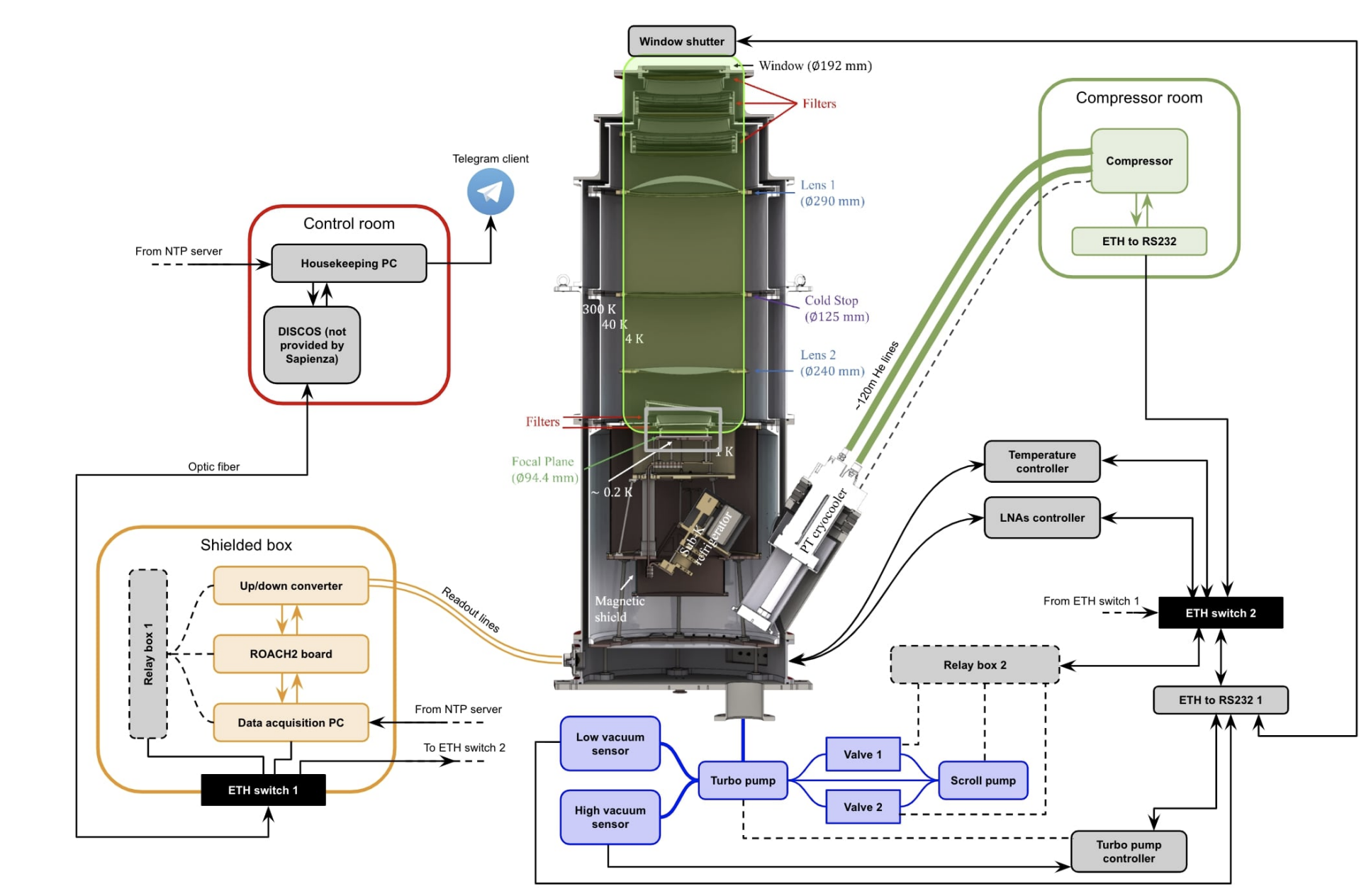
The MISTRAL Instrument
In this contribution, we describe the design and the laboratory tests of the detector array of the MISTRAL instrument. This detector array is made of 415 lumped element kinetic inductance detectors (LEKIDs). MIISTRAL is a cryogenic, high-angular-resolution, W–band camera for the Gregorian focus of the Sardinia Radio Telescope (SRT), an Italian 64 m diameter radio telescope. MISTRAL operates at a base temperature in the range between 200 and 240 mK under an optical load of few pW. Electrical and optical characterizations of the array have been carried out in several laboratory tests and its performance has been measured. We show the results of the performance measurements such as detector quality factors, quasiparticle lifetime, electrical and optical responsivity, optical efficiency. We also describe the procedure of the pixel identification on the focal plane.